
|
You entered: orbit
 The Sun in Three Dimensions
24.04.2007
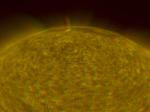
What does the Sun look like in all three spatial dimensions? To find out, NASA launched two STEREO satellites to perceive three dimensions on the Sun much like two eyes allow humans to perceive three dimensions on the Earth.
 Iapetus in Black and White
14.09.2007
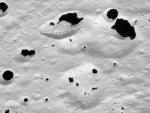
Iapetus, Saturn's third largest moon, is a candidate for the strangest moon of Saturn. Tidally locked in its orbit around the ringed gas giant, Iapetus is sometimes called the yin-yang moon because...
 Colors of Mercury
1.03.2013
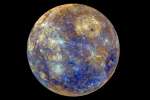
The colors of the solar system's innermost planet are enhanced in this tantalizing view, based on global image data from the Mercury-orbiting MESSENGER spacecraft. Human eyes would not discern the clear color differences but they are real none the less, indicating distinct chemical, mineralogical, and physical regions across the cratered surface.
 Two Views of Earth
23.07.2013
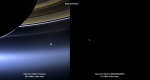
In a cross-Solar System interplanetary first, our Earth was photographed during the same day from both Mercury and Saturn. Pictured on the left, Earth is the pale blue dot just below the rings of Saturn, as captured by the robotic Cassini spacecraft now the gas giant.
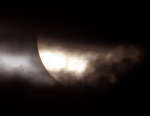 Mercurys Transit: An Unusual Spot on the Sun
24.08.2014
What's that dot on the Sun? If you look closely, it is almost perfectly round. The dot is the result of an unusual type of solar eclipse that occurred in 2006. Usually it is the Earth's Moon that eclipses the Sun. This time, the planet Mercury took a turn.
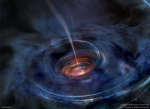 Black Hole Accreting with Jet
27.03.2017
What happens when a black hole devours a star? Many details remain unknown, but recent observations are providing new clues. In 2014, a powerful explosion was recorded by the ground-based robotic telescopes of the All Sky Automated Survey for SuperNovae (ASAS-SN) project, and followed up by instruments including NASA's Earth-orbiting Swift satellite.
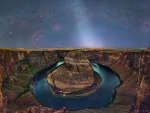 A Zodiacal Sky over Horseshoe Bend
22.05.2017
What's causing the unusual ray of white light extending upward from the central horizon? Dust orbiting the Sun. At certain times of the year, a band of sun-reflecting dust from the inner Solar System rises prominently before sunrise and is called zodiacal light.
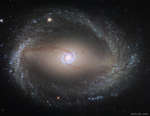 Spiral Galaxy NGC 1512: The Inner Ring
7.08.2017
Most galaxies don't have any rings -- why does this galaxy have two? To begin, the bright band near NGC 1512's center is a nuclear ring, a ring that surrounds the galaxy center and glows brightly with recently formed stars.
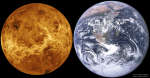 Venus Unveiled
10.02.2019
What does Venus look like beneath its thick clouds? These clouds keep the planet's surface hidden from even the powerful telescopic eyes of Earth-bound astronomers. In the early 1990s, though, using imaging radar...
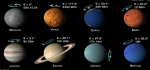 Planets of the Solar System: Tilts and Spins
20.05.2019
How does your favorite planet spin? Does it spin rapidly around a nearly vertical axis, or horizontally, or backwards? The featured video animates NASA images of all eight planets in our Solar System to show them spinning side-by-side for an easy comparison.
|
January February March April May June July August September |
|||||||||||||||||||||||||||||||||||||||||||||||||