
|
You entered: orbit
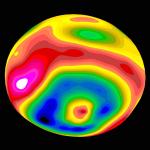 A Map of Asteroid Vesta
20.08.2006
Vesta is a huge rock 500 kilometers across that orbits out past Mars. In 1997, the above map of Vesta created using the Hubble Space Telescope was released showing a rugged surface highlighted by a single crater spanning nearly the entire length of the asteroid.
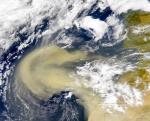 Dust Storm on Planet Earth
3.03.2000
From low Earth orbit, NASA's SeaWIFS instrument records ocean color, tracking changes in our water world's climate and biosphere. But even an ocean planet can have dust storms. On February 26th, SeaWIFS...
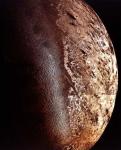 Triton: Neptune's Largest Moon
10.10.1999
One hundred and fifty three years ago, on October 10th, 1846, William Lassell was observing the newly discovered planet Neptune. He was attempting to confirm his observation, made just the previous week, that Neptune had a ring. But this time he discovered that Neptune had a satellite as well.
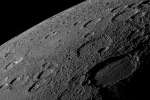 Mercurys Horizon from MESSENGER
21.01.2008
What would it look like to fly past Mercury? Just such an adventure was experienced last week by the MESSENGER spacecraft during its first flyby of the strange moon-like world nearest the Sun. Pictured above is the limb of Mercury seen by MESSENGER upon approach, from about 1 1/2 Earth diameters away.
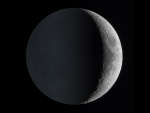 Sunshine, Earthshine
19.03.2015
Today's date marks an Equinox and a New Moon. Remarkably, while the exact timing of both geocentric events occur within a span of only 13 hours, the moon also reaches its new phase only 14 hours after perigee, the closest point in its orbit.
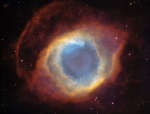 The Helix Nebula from Blanco and Hubble
23.08.2020
How did a star create the Helix nebula? The shapes of planetary nebula like the Helix are important because they likely hold clues to how stars like the Sun end their lives. Observations...
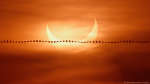 Eclipse Flyby
11.06.2021
On June 10 a New Moon passed in front of the Sun. In silhouette only two days after reaching apogee, the most distant point in its elliptical orbit, the Moon's small apparent size helped create an annular solar eclipse.
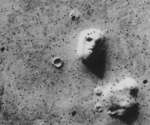 The Face on Mars
4.07.2021
Wouldn't it be fun if clouds were castles? Wouldn't it be fun if the laundry on the bedroom chair was a superhero? Wouldn't it be fun if rock mesas on Mars were interplanetary monuments to the human face? Clouds, though, are floating droplets of water and ice.
 Tau Herculids from Space
4.06.2022
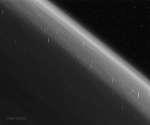
On May 31 tens of parallel meteor streaks were recorded in this 8 degree wide field of view of planet Earth's limb from space. The image is one of a series of 5 minute long observations by the orbiting Yangwang-1 space telescope.
 The Fairy of Eagle Nebula
25.09.2022
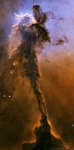
The dust sculptures of the Eagle Nebula are evaporating. As powerful starlight whittles away these cool cosmic mountains, the statuesque pillars that remain might be imagined as mythical beasts. Featured here is one of several striking dust pillars of the Eagle Nebula that might be described as a gigantic alien fairy.
|
January February March April May June July August September |
|||||||||||||||||||||||||||||||||||||||||||||||||