
|
You entered: Moon
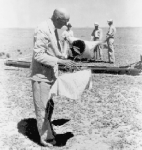 Rockets and Robert Goddard
15.06.1997
Robert H. Goddard, one of the founding fathers of modern rocketry, was born in Worcester Massachusetts in 1882. As a 16 year old, Goddard read H.G. Wells' science fiction classic "War Of The Worlds" and dreamed of spaceflight. By 1926 he had designed, built, and launched the world's first liquid fuel rocket.
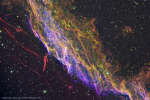 NGC 6992: Filaments of the Veil Nebula
1.12.2009
Wisps like this are all that remain visible of a Milky Way star. About 7,500 years ago that star exploded in a supernova leaving the Veil Nebula, also known as the Cygnus Loop.
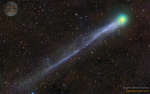 Comet Lovejoy s Tail
16.01.2015
Sweeping north in planet Earth's sky, Comet Lovejoy's greenish coma and blue tinted ion tail stretched across this field of stars in the constellation Taurus on January 13. The inset at the upper left shows the 1/2 degree angular size of the full moon for scale.
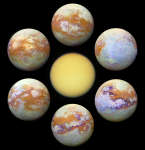 Seeing Titan
31.03.2023
Shrouded in a thick atmosphere, Saturn's largest moon Titan really is hard to see. Small particles suspended in the upper atmosphere cause an almost impenetrable haze, strongly scattering light at visible wavelengths and hiding Titan's surface features from prying eyes.
 Apollo 17 s Moonship
27.12.2025
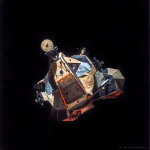
Awkward and angular looking, Apollo 17's lunar module Challenger was designed for flight in the near vacuum of space. Digitally enhanced and reprocessed, this picture taken from Apollo 17's command module America shows Challenger's ascent stage in lunar orbit.
 APOD: 2026 August 20 Б The Elephant s Trunk in Cepheus
20.08.2026
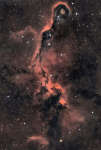
Like an illustration in a galactic Just So Story, the Elephant's Trunk Nebula winds through the emission region and young star cluster complex IC 1396, in the high and far off constellation of Cepheus. Also known as vdB 142, this cosmic elephant's trunk is over 20 light-years long.
 Rockets and Robert Goddard
18.07.1998
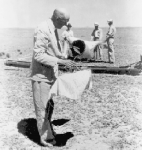
Robert H. Goddard, one of the founding fathers of modern rocketry, was born in Worcester Massachusetts in 1882. As a 16 year old, Goddard read H.G. Wells' science fiction classic "War Of The Worlds" and dreamed of spaceflight. By 1926 he had designed, built, and launched the world's first liquid fuel rocket.
 Eclipsing the Sun
5.01.2011
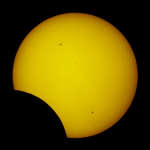
Skywatchers throughout much of Europe, North Africa, and Central Asia, were treated to the first eclipse of the new year on January 4, a partial eclipse of the Sun. But traveling to the area...
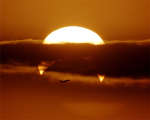 Partial Solar Eclipse with Airplane
13.05.2013
It was just eight minutes after sunrise, last week, and already there were four things in front of the Sun. The largest and most notable was Earth's Moon, obscuring a big chunk of the Sun's lower limb as it moved across the solar disk, as viewed from Fremantle, Australia.
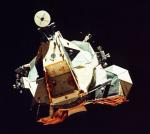 Apollo 17's Moonship
6.01.2001
Awkward and angular looking, Apollo 17's lunar module Challenger was designed for flight in the vacuum of space. This sharp picture from the command module America, shows Challenger's ascent stage in lunar orbit.
|
January February March April May June July August September October |
|||||||||||||||||||||||||||||||||||||||||||||||||