
|
You entered: astronomer
 Mira: The Wonderful Star
5.05.2005
To seventeenth century astronomers, Omicron Ceti or Mira was known as a wonderful star - a star whose brightness could change dramatically in the course of about 11 months. Modern astronomers now recognize an entire class of long period Mira-type variables as cool, pulsating, red giant stars, 700 or so times the diameter of the Sun.
 Rumors of a Dark Universe
4.08.2019
Twenty-one years ago results were first presented indicating that most of the energy in our universe is not in stars or galaxies but is tied to space itself. In the language of cosmologists, a large cosmological constant -- dark energy -- was directly implied by new distant supernova observations.
 The Nebula And The Neutron Star
1.02.2003
The lonely RX J1856.5-3754 was formed from the collapsed core of an exploding star. At a distance of 180 light-years it is the closest known neutron star. More massive than...
 The Central Milky Way from Lagoon to Pipe
1.10.2021
Dark markings and colorful clouds inhabit this stellar landscape. The deep and expansive view spans more than 30 full moons across crowded star fields toward the center of our Milky Way Galaxy. Cataloged in the early 20th century by astronomer E. E.
 Rumors of a Strange Universe
2.12.2001
Three years ago results were first presented indicating that most of the energy in our universe is not in stars or galaxies but is tied to space itself. In the language of cosmologists, a large cosmological constant is directly implied by new distant supernovae observations.
 Quadrantid Meteors and Aurora from the Air
7.01.2008
Where do meteor showers originate? To help answer this question, astronomers studied in some detail the Quadrantid meteor shower that occurred over this past weekend. In particular, astronomers with specialized cameras flew as part...
 NGC 7789: Caroline's Rose
15.11.2017
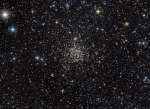
Found among the rich starfields of the Milky Way, star cluster NGC 7789 lies about 8,000 light-years away toward the constellation Cassiopeia. A late 18th century deep sky discovery of astronomer Caroline Lucretia Herschel, the cluster is also known as Caroline's Rose.
 NGC 7789: Caroline s Rose
6.07.2024
Found among the rich starfields of the Milky Way, star cluster NGC 7789 lies about 8,000 light-years away toward the constellation Cassiopeia. A late 18th century deep sky discovery of astronomer Caroline Lucretia Herschel, the cluster is also known as Caroline's Rose.
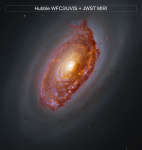 APOD: 2026 September 16 Б Webb's View of M64
16.09.2026
Sometimes where Hubble finds darkness, Webb sees light. An example is todayБs composite images of Messier 64 (M64), a nearby spiral galaxy of many names. The dark band of dust partially blocking its bright core earned it the moniker Бthe Black Eye Galaxy.
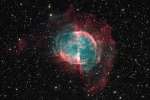 M27: Not a Comet
26.08.2010
While hunting for comets in the skies above 18th century France, astronomer Charles Messier diligently kept a list of the things he encountered that were definitely not comets. This is number 27 on his now famous not-a-comet list.
|
January February March April May June July August September |
|||||||||||||||||||||||||||||||||||||||||||||||||