
|
You entered: astronomer
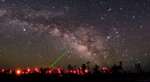 Messier Marathon
27.05.2011
In this action scene, red night vision lights, green laser pointers, tripods and telescopes in faint silhouette surround intrepid sky gazers embarked on the 10th annual Iran Messier Marathon. Completing the marathon requires viewing all 110 objects in 18th century French astronomer Charles Messier's catalog in one glorious dusk-to-dawn observing run.
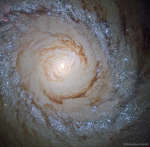 Starburst Galaxy M94 from Hubble
31.07.2022
Why does this galaxy have a ring of bright blue stars? Beautiful island universe Messier 94 lies a mere 15 million light-years distant in the northern constellation of the Hunting Dogs (Canes Venatici).
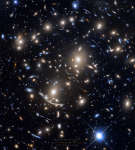 Abell 370: Galaxy Cluster Gravitational Lens
19.03.2019
What are those strange arcs? While imaging the cluster of galaxies Abell 370, astronomers noticed an unusual arc. The arc wasn't understood right away -- not until better images showed that...
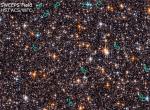 The Hubble SWEEPS Field
13.10.2006
This crowded star field towards the center of our Milky Way Galaxy turns out to be a great place to search for planets beyond our solar system. In fact, repeatedly imaging about...
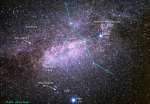 Where is HD 189733
21.03.2008
The star cataloged as HD 189733 is a mere 63 light-years away. Its location is indicated in this deep, wide-angle image of the sky centered on the northern constellation of Cygnus. Considering the many...
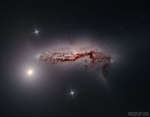 Galaxy Group Hickson 90
17.05.2017
Scanning the skies for galaxies, Canadian astronomer Paul Hickson and colleagues identified some 100 compact groups of galaxies, now appropriately called Hickson Compact Groups (HCGs). This sharp Hubble image shows one such galaxy group, HCG 90, in startling detail.
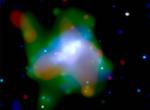 NGC 1569: Heavy Elements from a Small Galaxy
25.07.2002
For astronomers, elements other than hydrogen and helium are sometimes considered to be simply "heavy elements". It's understandable really, because even lumped all together heavy elements make up an exceedingly small fraction of the Universe. Still, heavy elements can profoundly influence galaxy and star formation ... not to mention the formation of planets and people.
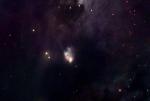 McNeil s Nebula
19.02.2004
It was a clear, cold western Kentucky night on January 23rd as seasoned amateur astronomer Jay McNeil tried out his recently acquired 3-inch refracting telescope by imaging the area around a familiar object, the M78 reflection nebula in Orion.
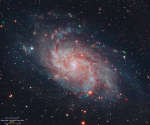 APOD: 2026 September 18 Б Messier 33: The Triangulum Galaxy
18.09.2026
The small, northern constellation Triangulum harbors this magnificent face-on spiral galaxy, Messier 33. Its popular names include the Pinwheel Galaxy or just the Triangulum Galaxy. M33 is over 50,000 light-years in diameter, third largest in the Local Group of galaxies after the Andromeda Galaxy (M31), and our own Milky Way.
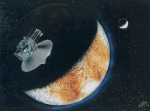 Pluto Not Yet Explored
12.02.1996
Cold, distant, Pluto is the only planet in our Solar System which has not been visited by a spacecraft from Earth. The story goes that the legend "Pluto Not Yet Explored" on a US postal stamp depicting the tiny, mysterious world inspired a JPL employee to develop plans for a Pluto flyby.
|
January February March April May June July August September |
|||||||||||||||||||||||||||||||||||||||||||||||||