
|
You entered: surface
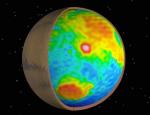 Inside Mars
22.03.2000
What's inside Mars? From orbit, the Mars Global Surveyor (MGS) spacecraft has recorded detailed images of the red planet since July 1997. Still, its cameras can not look beneath the surface. But minute...
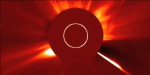 Comet and CME on the Sun
5.10.2011
Did a sun-diving comet just cause a solar explosion? Probably not. This past weekend a comet dove toward the Sun and was followed very quickly by a Coronal Mass Ejection (CMEs) from the other side of the Sun.
 Eclipse Over New York
4.11.2013
A sunrise over New York City rarely looks like this. Yesterday, however, the Sun rose partly eclipsed by the Moon as seen from much of the eastern North American and northern South America. Simultaneously, much of Africa, already well into daytime, saw the eclipse from beginning to end.
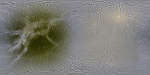 The Map of Dione
6.11.2014
This cylindrical projection global map is one of six new color maps of Saturn's midsized icy moons, constructed using 10 years of image data from the Cassini spacecraft. Discovered by Cassini (the astronomer) in 1684, Dione is about 1,120 kilometers across.
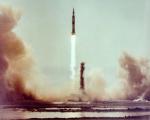 Happy Birthday Jules Verne
14.02.2003
One hundred seventy-five years ago (on February 8th), Jules Verne was born in Nantes, France. Inspired by a lifelong fascination with machines, Verne wrote visionary works about "Extraordinary Voyages" including such terrestrial travels as Around the World in 80 Days, Journey to the Centre of the Earth, and Twenty Thousand Leagues Under the Sea.
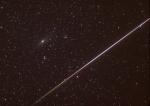 Island Universe, Cosmic Sand
2.08.2003
On August 13, 2002, while counting Perseid meteors under dark, early morning Arizona skies, Rick Scott set out to photograph their fleeting but fiery trails. The equipment he used included a telephoto lens and fast color film. After 21 pictures he'd caught only two meteors, but luckily this was one of them.
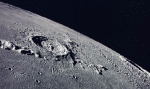 The Barren Moon
2.01.1998
The above photo, taken as the Apollo 17 astronauts orbited the Moon in 1972, depicts the stark lunar surface around the Eratosthenes and Copernicus craters. Many similar images of a Moon devoid of life are familiar to denizens of the space age.
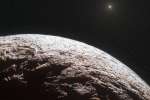 Makemake of the Outer Solar System
26.12.2012
Makemake is one of the largest objects known in the outer Solar System. Pronounced MAH-kay MAH-kay, this Kuiper belt object is about two-thirds the size of Pluto, orbits the Sun only slightly further out than Pluto, and appears only slightly dimmer than Pluto.
 APOD: 2023 July 31 Б Phobos over Mars
30.07.2023
Why is Phobos so dark? Phobos, the largest and innermost of the two Martian moons, is the darkest moon in the entire Solar System. Its unusual orbit and color indicate that it may be a captured asteroid composed of a mixture of ice and dark rock.
 A Perseid Below
8.08.2024
Denizens of planet Earth typically watch meteor showers by looking up. But this remarkable view, captured on August 13, 2011 by astronaut Ron Garan, caught a Perseid meteor by looking down. From Garan...
|
January February March April May June July August September October |
|||||||||||||||||||||||||||||||||||||||||||||||||