
|
You entered: surface
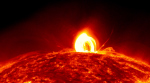 Coronal Rain on the Sun
27.05.2018
Does it rain on the Sun? Yes, although what falls is not water but extremely hot plasma. An example occurred in mid-July 2012 after an eruption on the Sun that produced both a Coronal Mass Ejection and a moderate solar flare. What was more unusual, however, was what happened next.
 Astronaut Exploring: An Apollo 15 Panorama
11.11.2018
What would it be like to explore the Moon? NASA's Apollo missions gave humans just this chance in the late 1960s and early 1970s. In particular, the Apollo 15 mission was dedicated to better understanding the surface of the Moon by exploring mountains, valleys, maria, and highlands.
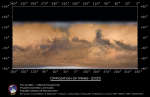 Global Map: Mars at Opposition
20.11.2020
This may be the best global Mars map made with a telescope based on planet Earth. The image data were captured by a team of observers over six long nights...
 Shackleton from ShadowCam
5.05.2023
Shackleton crater lies at the lunar south pole. Peaks along the 21 kilometer diameter are in sunlight, but Shackleton's floor is in dark permanent shadow. Still, this image of the shadowed rim wall...
 Welcome to Perihelion
4.01.2025
Earth's orbit around the Sun is not a circle, it's an ellipse. The point along its elliptical orbit where our fair planet is closest to the Sun is called perihelion. This year perihelion is today, January 4, at 13:28 UTC, with the Earth about 147 million kilometers from the Sun.
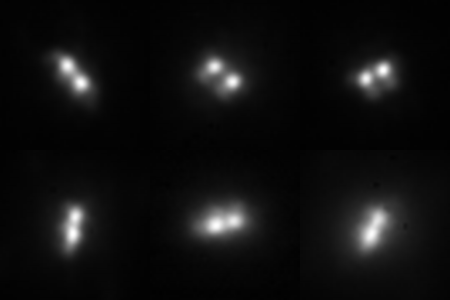 Double Asteroid 90 Antiope
1.11.2000
This eight-frame animation is based on the first ever images of a double asteroid! Formerly thought to be a single enormous chunk of rock, asteroid 90 Antiope resides in the solar system's main asteroid belt between Mars and Jupiter.
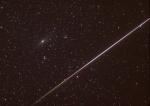 Island Universe, Cosmic Sand
23.08.2002
On August 13, while counting Perseid meteors under dark, early morning Arizona skies, Rick Scott set out to photograph their fleeting but fiery trails. The equipment he used included a telephoto lens and fast color film. After 21 pictures he'd caught only two meteors, but luckily this was one of them.
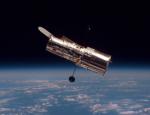 Hubble Floats Free
6.03.1997
Why put observatories in space? Most telescopes are on the ground. On the ground, you can deploy a heavier telescope and upgrade it more easily. The trouble is that Earth-bound telescopes must look through the Earth's atmosphere.
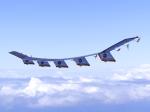 The Flight Of Helios
22.07.2007
An example of solar-powered flight, NASA's Helios aircraft flew almost one hundred years after the Wright brothers' historic flight on December 17, 1903. Pictured here at 10,000 feet in in skies northwest of Kauai, Hawaii in August 2001, the remotely piloted Helios is traveling at about 25 miles per hour.
 An Apollo 15 Panorama: Astronaut Exploring
30.11.2008
What would it be like to explore the Moon? NASA's Apollo missions gave humans just this chance in the late 1960s and early 1970s. In particular, the Apollo 15 mission was dedicated to better understanding the surface of the Moon by exploring mountains, valleys, maria, and highlands.
|
January February March April May June July August September October |
|||||||||||||||||||||||||||||||||||||||||||||||||