
|
You entered: time
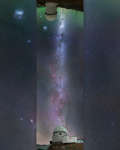 A 10 000 Kilometer Galactic Bridge
2.06.2022
With this creative astro-collaboration you can follow the plane of our Milky Way Galaxy as it bridges northern and southern hemisphere skies. To construct the expansive composite nightscape, skies over Observatorio El Sauce...
 APOD: 2023 August 22 Б The Pistachio Nebula
21.08.2023
This nebula had never been noted before. Newly discovered nebulas are usually angularly small and found by professionals using large telescopes. In contrast, the Pistachio Nebula was discovered by dedicated amateurs and, although faint, is nearly the size of the full Moon.
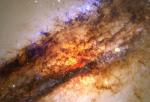 The Center of Centaurus A
22.05.1998
A fantastic jumble of young blue star clusters, gigantic glowing gas clouds, and imposing dark dust lanes surrounds the central region of the active galaxy Centaurus A. This mosaic of Hubble Space Telescope images taken in blue, green, and red light has been processed to present a natural color picture of this cosmic maelstrom.
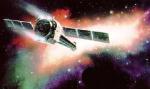 Name This Satellite
20.04.1998
Can you name this satellite? In December, NASA's third Great Observatory is planned for launch. The two NASA Great Observatories currently in orbit are the Hubble Space Telescope and the Compton Gamma-Ray Observatory, both now named for famous scientists. But after whom should the Advanced X-ray Astrophysics Facility (AXAF) be named?
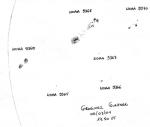 Islands in the Photosphere
25.10.2003
Awash in a sea of plasma and anchored in magnetic fields, sunspots are planet-sized, dark islands in the solar photosphere, the bright surface of the Sun. Before the enlightened(!) age of cameras, solar observers created detailed drawings of sunspots as they changed and progressed across the visible solar disk.
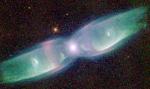 M2 9: Wings of a Butterfly Nebula
31.01.2004
Are stars better appreciated for their art after they die? Actually, stars usually create their most artistic displays as they die. In the case of low-mass stars like our Sun and M2-9 pictured above, the stars transform themselves from normal stars to white dwarfs by casting off their outer gaseous envelopes.
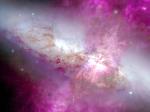 The Supergalactic Wind from Starburst Galaxy M82
1.06.2004
Star formation occurs at a faster pace in M82 -- a galaxy with about ten times the rate of massive star birth (and death) compared to our Milky Way. Winds from massive stars and blasts from supernova explosions have created a billowing cloud of expanding gas from this remarkable starburst galaxy.
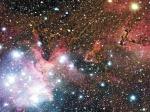 In the Center of the Heart Nebula
7.12.2004
What powers the Heart Nebula? The large emission nebula dubbed IC 1805 looks, in whole, like a human heart. The nebula glows brightly in red light emitted by its most prominent element: hydrogen. The red glow and the larger shape are all created by a small group of stars near the nebula's center.
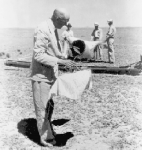 Rockets and Robert Goddard
17.07.1999
Robert H. Goddard, one of the founding fathers of modern rocketry, was born in Worcester Massachusetts in 1882. As a 16 year old, Goddard read H.G. Wells' science fiction classic "War Of The Worlds" and dreamed of space flight. By 1926 he had designed, built, and launched the world's first liquid fuel rocket.
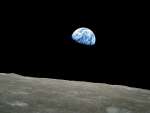 Earthrise
23.12.2008
Forty years ago, in December of 1968, the Apollo 8 crew flew from the Earth to the Moon and back again. Frank Borman, James Lovell, and William Anders were launched atop a Saturn V rocket on December 21, circled the Moon ten times in their command module, and returned to Earth on December 27.
|
January February March April May June July August September |
|||||||||||||||||||||||||||||||||||||||||||||||||