
|
You entered: time
 Europa Rotating
16.01.2001
Evidence has been mounting that beneath the vast planes of ice that cover Europa lies water -- liquid oceans that might be home to alien life. The smallest of Jupiter's Galilean Moons (which include Io, Ganymede, and Callisto), Europa's deep interior is composed of mostly of silicate rock.
 Trailing Planets
10.05.2002
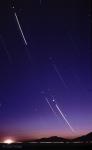
Positioning his camera and tripod on planet Earth, near Maricopa, Arizona, USA, astrophotographer Joe Orman created this trailing display of the ongoing sky-full-of-planets on May 3rd. He initially captured the grouping in a 20 second long time exposure recording the positions of the bright planets and stars.
 Nearby Spiral Galaxy NGC 4945
21.07.2002
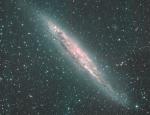
For such a close galaxy, NGC 4945 is easy to miss. NGC 4945 is a spiral galaxy in the Centaurus Group of galaxies, located only six times farther away than the prominent Andromeda Galaxy. The thin disk galaxy is oriented nearly edge-on, however, and shrouded in dark dust.
 Accretion Disk Binary System
26.12.1995
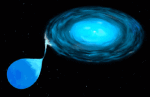
Our Sun is unusual in that it is alone - most stars occur in multiple or binary systems. In a binary system, the higher mass star will evolve faster and will eventually become a compact object - either a white dwarf star, a neutron star, or black hole.
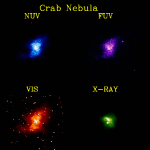 The High Energy Crab Nebula
22.11.1998
This is the mess that is left when a star explodes. The Crab Nebula is so energetic that it glows in every kind of light known. Shown above are images of the Crab Nebula from visible light to the X-ray band.
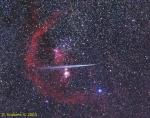 Rocket Fuel
16.11.2007
This gorgeous image of Orion shows off the constellation's young stars and cosmic clouds of hydrogen gas and dust. Made with a film camera tracking the stars on November 11, the exposure lasted some 40 minutes.
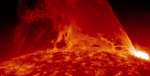 A Solar Prominence Eruption from SDO
26.05.2019
One of the most spectacular solar sights is an erupting prominence. In 2011, NASA's Sun-orbiting Solar Dynamic Observatory spacecraft imaged an impressively large prominence erupting from the surface. The dramatic explosion was captured in ultraviolet light in the featured time lapse video covering 90 minutes, where a new frame was taken every 24 seconds.
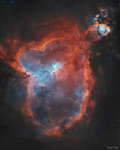 IC 1805: The Heart Nebula
11.09.2019
What energizes the Heart Nebula? First, the large emission nebula dubbed IC 1805 looks, in whole, like a human heart. The nebula glows brightly in red light emitted by its most prominent element: hydrogen. The red glow and the larger shape are all powered by a small group of stars near the nebula's center.
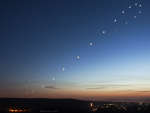 Analemma of the Moon
7.05.2020
An analemma is that figure-8 curve you get when you mark the position of the Sun at the same time each day for one year. But the trick to imaging an analemma of the Moon is to wait bit longer.
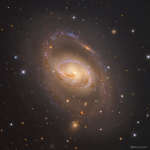 Messier 96
14.04.2022
Spiral arms seem to swirl around the core of Messier 96 in this colorful, detailed portrait of a beautiful island universe. Of course M96 is a spiral galaxy, and counting the faint arms extending beyond the brighter central region it spans 100 thousand light-years or so.
|
January February March April May June July August September |
|||||||||||||||||||||||||||||||||||||||||||||||||