
|
You entered: astronomer
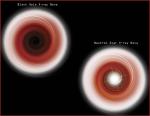 Black Holes Are Black
19.01.2001
Q: Why are black holes black? A: Because they have an event horizon. The event horizon is that one-way boundary predicted by general relativity beyond which nothing, not even light, can return. X-ray astronomers...
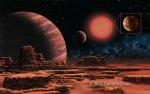 Gliese 876 System Includes Large Terrestrial Planet
14.06.2005
Is our Earth unique? In continuing efforts to answer this question, astronomers have now discovered an Earth-like planet orbiting a distant normal star. Previously over 150 gas-giant planets like Jupiter had been so discovered.
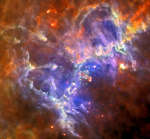 Inside the Eagle Nebula
3.02.2012
In 1995, a now famous picture from the Hubble Space Telescope featured Pillars of Creation, star forming columns of cold gas and dust light-years long inside M16, the Eagle Nebula. This remarkable false-color composite image revisits the nearby stellar nursery with image data from the orbiting Herschel Space Observatory and XMM-Newton telescopes.
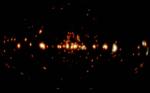 A Mystery in Gamma Rays
3.04.2004
Gamma rays are the most energetic form of light, packing a million or more times the energy of visible light photons. If you could see gamma rays, the familiar skyscape of steady stars would be replaced by some of the most bizarre objects known to modern astrophysics -- and some which are unknown.
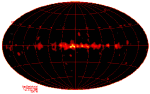 COMPTEL Explores The Radioactive Sky
24.07.1996
Diffuse gas clouds laced with radioactive aluminum atoms (Al26) line the plane of our Milky Way Galaxy! How do we see them? Relying on the Compton Effect, the COMPTEL instrument onboard NASA's immense orbiting Compton Gamma Ray Observatory can "see" the 1.8 million electron Volt gamma rays emitted by the radioactive decay.
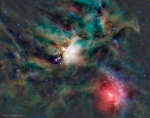 Young Stars in the Rho Ophiuchi Cloud
17.11.2019
How do stars form? To help find out, astronomers created this tantalizing false-color composition of dust clouds and embedded newborn stars in infrared wavelengths with WISE, the Wide-field Infrared Survey Explorer. The cosmic canvas...
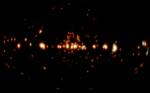 A Mystery in Gamma Rays
24.03.2000
Gamma rays are the most energetic form of light, packing a million or more times the energy of visible light photons. What if you could see gamma rays? If you could, the familiar skyscape...
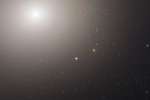 The Densest Galaxy
4.10.2013
The bright core and outer reaches of giant elliptical galaxy M60 (NGC 4649) loom large at the upper left of this sharp close-up from the Hubble Space Telescope. Some 54 million light-years away and 120,000 light-years across, M60 is one of the largest galaxies in the nearby Virgo Cluster.
 New Moons For Saturn
3.11.2000
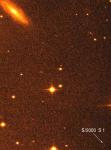
Which planet has the most moons? For now, it's Saturn. Four newly discovered satellites bring the ringed planet's total to twenty-two, just edging out Uranus' twenty-one for the most known moons in the solar system. Of course, the newfound Saturnian satellites are not large and photogenic.
 Julius Caesar and Leap Days
29.02.2000
Even as leap days go, today is a remarkable one. In 46 BC, Julius Caesar, pictured above in a self-decreed minted coin, created a calendar system that added one leap day every four years.
|
January February March April May June July August September |
|||||||||||||||||||||||||||||||||||||||||||||||||