
|
You entered: astronomer
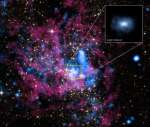 The Quiet Sagittarius A
6.09.2013
Hot gas is hard to swallow. At least that seems to be true for the supermassive black hole at the center of our Milky Way Galaxy. Known as source Sagittarius A*, the Milky Way's black hole is centered in this infrared (red and yellow hues) and X-ray (blue) composite.
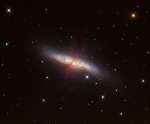 Bright Supernova in M82
24.01.2014
Astronomers really don't find supernovae by looking for the arrows. But in this image taken January 23rd, an arrow does point to an exciting, new supernova, now cataloged as SN 2014J, in nearby bright galaxy M82.
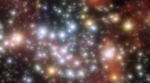 Journey to the Center of the Galaxy
29.07.2018
What wonders lie at the center of our Galaxy? In Jules Verne's science fiction classic A Journey to the Center of the Earth, Professor Liedenbrock and his fellow explorers encounter many strange and exciting wonders.
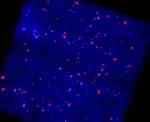 X-Rays from the Galactic Plane
14.08.2001
In February 2000, the orbiting Chandra X-ray Observatory spent 27 hours staring into the plane of our Milky Way galaxy. Its target was a spot in the small constellation Scutum, within the Milky Way's zone of avoidance where galactic gas and dust clouds block visible light, making a poor window for optical telescopes.
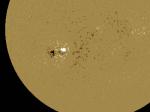 A Backward Sunspot and the New Solar Cycle
30.08.2006
Why is sunspot 905 backwards? Perhaps it is a key marker for the beginning of a new magnetic cycle on our Sun. Every 11 years, our Sun goes through a magnetic cycle, at the end of which its overall magnetic orientation is reversed.
 APOD: 2025 August 22 Б A Tale of Two Nebulae
22.08.2025
This colorful telescopic view towards the musical northern constellation Lyra reveals the faint outer halos and brighter central ring-shaped region of M57, popularly known as the Ring Nebula. To modern astronomers M57 is a well-known planetary nebula.
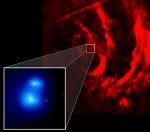 Around The Arches Cluster
14.06.2001
The most compact cluster of stars known in our galaxy, the Arches cluster, boasts 100 or so massive, young stars contained within a diameter of one light-year. Seen toward the constellation Sagittarius, the Arches...
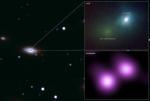 SN 2006GY: Brightest Supernova
10.05.2007
The stellar explosion cataloged as supernova SN 2006gy shines in this wide-field image (left) of its host galaxy, NGC 1260, and expanded view (upper right panel) of the region surrounding the galaxy's core.
 UHZ1: Distant Galaxy and Black Hole
10.11.2023
Dominated by dark matter, massive cluster of galaxies Abell 2744 is known to some as Pandora's Cluster. It lies 3.5 billion light-years away toward the constellation Sculptor. Using the galaxy cluster's enormous...
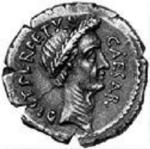 Julius Caesar and Leap Days
29.02.2004
Today, February 29th, is a leap day - a relatively rare occurrence. In 46 BC, Julius Caesar, pictured above in a self-decreed minted coin, created a calendar system that added one leap day every four years.
|
January February March April May June July August |
||||||||||||||||||||||||||||||||||||||||||||||||||||||||