
|
You entered: crescent
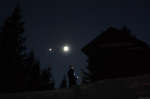 Alpine Conjunction
2.01.2009
Did you see it? The last conjunction of Moon and bright planets in 2008 featured a young crescent Moon and brilliant Venus in the west after sunset on December 31st. Seen here in dark, clear, mountain air from Mönichkirchen, Austria, are the two celestial beacons that dominate planet Earth's night sky.
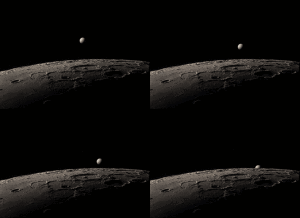 Lunar Occultation of Venus
2.06.2022
On May 27 Venus rose as the morning star, near the waning crescent Moon in a predawn sky already full of planets. It was close on the sky to the Moon's crescent and a conjunction of the second an third brightest celestial beacons were enjoyed by skygazers around the world.
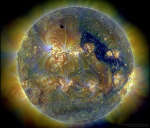 Venus and the Triply Ultraviolet Sun
6.03.2022
This was a very unusual type of solar eclipse. Typically, it is the Earth's Moon that eclipses the Sun. In 2012, though, the planet Venus took a turn. Like a solar eclipse by the Moon, the phase of Venus became a continually thinner crescent as Venus became increasingly better aligned with the Sun.
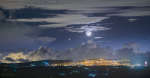 Earthshine Moon over Sicily
18.10.2021
Why can we see the entire face of this Moon? When the Moon is in a crescent phase, only part of it appears directly illuminated by the Sun. The answer is earthshine, also known as earthlight and the da Vinci glow.
 APOD: 2024 January 8 Б The Phases of Venus
8.01.2024
Venus goes through phases. Just like our Moon, Venus can appear as a full circular disk, a thin crescent, or anything in between. Venus, frequently the brightest object in the post-sunset or pre-sunrise sky, appears so small, however, that it usually requires binoculars or a small telescope to clearly see its current phase.
 Venus and the Triply Ultraviolet Sun
20.08.2013
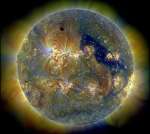
An unusual type of solar eclipse occurred last year. Usually it is the Earth's Moon that eclipses the Sun. Last June, most unusually, the planet Venus took a turn. Like a solar eclipse by the Moon, the phase of Venus became a continually thinner crescent as Venus became increasingly better aligned with the Sun.
 Mercurys Transit: An Unusual Spot on the Sun
8.05.2016
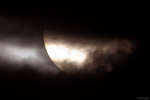
What's that dot on the Sun? If you look closely, it is almost perfectly round. The dot is the result of an unusual type of solar eclipse that occurred in 2006. Usually it is the Earth's Moon that eclipses the Sun. This time, the planet Mercury took a turn.
 Venus and the Triply Ultraviolet Sun
4.02.2018
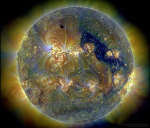
An unusual type of solar eclipse occurred in 2012. Usually it is the Earth's Moon that eclipses the Sun. That year, most unusually, the planet Venus took a turn. Like a solar eclipse by the Moon, the phase of Venus became a continually thinner crescent as Venus became increasingly better aligned with the Sun.
 APOD: 2025 March 16 Б Venus and the Triply Ultraviolet Sun
16.03.2025
This was a very unusual type of solar eclipse. Typically, it is the Earth's Moon that eclipses the Sun. In 2012, though, the planet Venus took a turn. Like a solar eclipse by the Moon, the phase of Venus became a continually thinner crescent as Venus became increasingly better aligned with the Sun.
 Moon Occults Venus
21.06.2020
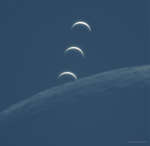
It may look like Earthrise, but it's actually Venus-set. Just after sunrise two days ago, both the Moon and Venus also rose. But then the Moon overtook Venus. In the featured image sequence centered on the Moon, Venus is shown increasingly angularly close to the Moon.
|
January February March April May June July August |
||||||||||||||||||||||||||||||||||||||||||||||||||||||||