
|
You entered: space
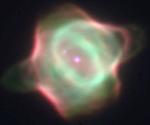 Hen 1357: New Born Nebula
3.04.1998
This Hubble Space Telescope picture shows Hen-1357, the youngest known planetary nebula. Graceful, gentle curves and symmetry suggest its popular name - The Stingray Nebula. Observations in the 1970s detected no nebular material, but this image from March 1996 clearly shows the Stingray's emerging bubbles and rings of shocked and ionized gas.
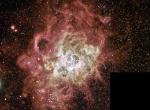 NGC 604: Giant Stellar Nursery
9.12.2003
Stars are sometimes born in the midst of chaos. About 3 million years ago in the nearby galaxy M33, a large cloud of gas spawned dense internal knots which gravitationally collapsed to form stars. NGC 604 was so large, however, it could form enough stars to make a globular cluster.
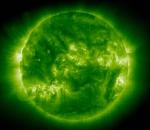 The Iron Sun
25.09.2004
The ultraviolet light emitted by eleven times ionized iron at temperatures over 2 million degrees Farenheit was used to record the above picture of the Sun on September 22, 2001, the date of that year's autumnal equinox.
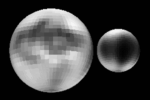 Mysterious Pluto and Charon
9.04.2000
Pluto is the only planet in our Solar System remaining unphotographed by a passing spacecraft. Distant Pluto and its moon Charon therefore remain somewhat mysterious. In addition to direct imaging by the Hubble Space...
 Aeolian Mars
2.02.2000
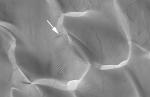
Mars' atmosphere is relatively thin, still when martian winds blow they weather and shape its surface. Like familiar aeolian features on Earth, this field of dunes within Mars' Rabe crater exhibits graceful undulating ridges which can shift as windblown material is deposited on the dunes' windward face and falls away down the steeper leeward slopes.
 The Cat's Eye Nebula
31.10.1999
Three thousand light-years away, a dying star throws off shells of glowing gas. This image from the Hubble Space Telescope reveals The Cat's Eye Nebula to be one of the most complex planetary nebulae known.
 Aurora Over Norway
20.09.2010
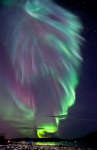
Auroras can make spectacular sights. Photographed above last weekend, flowing multi-colored auroras helped illuminate a busy sky above TromsЬ, Norway. Besides the spectacular aurora pictured above, the photographer caught three satellites streaks, one airplane streak, and a friend trying to capture the same sight.
 N159 in the Large Magellanic Cloud
28.01.2017
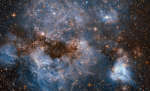
Over 150 light-years across, this cosmic maelstrom of gas and dust is not too far away. It lies south of the Tarantula Nebula in our satellite galaxy the Large Magellanic Cloud a mere 180,000 light-years distant. Massive stars have formed within.
 Saturns Rings from the Inside Out
4.09.2017
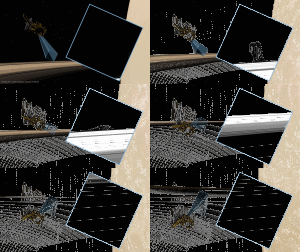
What do Saturn's rings look like from Saturn? Images from the robotic spacecraft Cassini are providing humanity with this unprecedented vantage point as it nears the completion of its mission. Previous to Cassini's Grand Finale orbits, all images of Saturn's majestic ring system were taken from outside of the rings looking in.
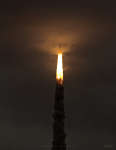 Chandrayaan 2 Launch
27.07.2019
On July 22nd this GSLV (Geosynchronous Satellite Launch Vehicle) MkIII rocket vanished from sight into a cloud bank an instant after this dramatic snapshot was taken. Launched from India's Satish Dhawan Space Centre it carried the Chandrayaan 2 mission spacecraft into Earth orbit.
|
January February March April May June July August September |
|||||||||||||||||||||||||||||||||||||||||||||||||