
|
You entered: space
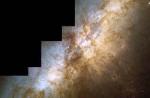 M82 After the Crash
12.03.2001
When did the Cigar Galaxy light up? Evidence indicates how M82, the Cigar Galaxy, became so bright and peculiar: it collided with neighboring galaxy M81. Astronomers become detectives, however, when trying to figure out when this collision occurred.
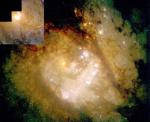 In the Center of Spiral Galaxy M83
6.11.2001
What's happening at the center of spiral galaxy M83? Just about everything, from the looks of it. M83, visible in the inset image on the upper left, is one of the closest spiral galaxies to our own Milky Way Galaxy and from a distance of 15 million light-years, appears to be relatively normal.
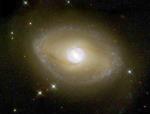 The Galactic Ring of NGC 6782
21.11.2001
Do spiral galaxies look the same in every color? NGC 6782 demonstrates colorfully that they do not. In visible light, NGC 6782 appears to be a normal spiral galaxy with a bright bar across its center.
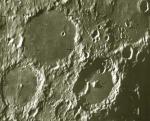 Hubble Resolves Expiration Date For Green Cheese Moon
1.04.2002
Using the new camera on the recently refitted Hubble Space Telescope, astronomers have been able to confirm that the Moon is made of green cheese. The telling clue was the resolution of a numeric date after which the Moon may go bad.
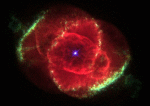 The Cat's Eye Nebula (Revisited)
4.07.1996
Three thousand light years away, a dying star throws off shells of glowing gas. This image from the Hubble Space Telescope reveals "The Cat's Eye Nebula" to be one of the most complex planetary nebulae known.
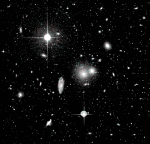 The Hydra Cluster of Galaxies
1.08.1996
You are flying through space and come to ... the Hydra Cluster of Galaxies. Listed as Abell 1060, the Hydra Cluster contains well over 100 bright galaxies. Clusters of galaxies are the largest gravitationally-bound objects in the universe.
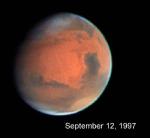 A Martian Autumn Begins
23.09.1997
Today is the first day of Autumn in the Northern Hemisphere of Planet Earth. The Autumnal Equinox occured yesterday at 7:56 pm EDT as the Sun crossed the celestial equator from North to South.
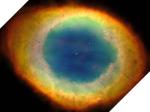 M57: The Ring Nebula
25.06.2006
It looked like a ring on the sky. Hundreds of years ago astronomers noticed a nebula with a most unusual shape. Now known as M57 or NGC 6720, the gas cloud became popularly known as the Ring Nebula.
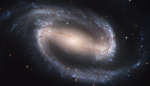 Barred Spiral Galaxy NGC 1300
25.03.2012
Big, beautiful, barred spiral galaxy NGC 1300 lies some 70 million light-years away on the banks of the constellation Eridanus. This Hubble Space Telescope composite view of the gorgeous island universe is one of the largest Hubble images ever made of a complete galaxy.
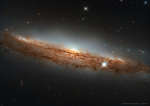 NGC 3717: A Nearly Sideways Spiral Galaxy
12.11.2019
Some spiral galaxies are seen nearly sideways. Most bright stars in spiral galaxies swirl around the center in a disk, and seen from the side, this disk can be appear quite thin. Some spiral galaxies appear even thinner than NGC 3717, which is actually seen tilted just a bit.
|
January February March April May June July August September |
|||||||||||||||||||||||||||||||||||||||||||||||||