
|
You entered: stars
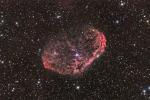 NGC 6888: The Crescent Nebula
11.11.2007
What caused the Crescent Nebula? Looking like an emerging space cocoon, the Crescent Nebula, visible in the center of the above image, was created by the brightest star in its center. A leading progenitor hypothesis has the Crescent Nebula beginning to form about 250,000 years ago.
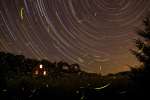 A Summer Night s Dream
5.08.2011
Fix your digital camera to a tripod, start a long series of exposures, and you too can record star trails. The concentric arcs traced by the stars as planet Earth rotates on its axis often produce dreamlike scenes in otherwise familiar situations. Fall asleep, though, and the results might surprise you.
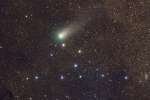 Comet Garradd and the Coat Hanger
9.09.2011
Sweeping through planet Earth's night sky, last weekend Comet Garradd (C/2009 P1) visited this lovely star field along the Milky Way in the constellation Vulpecula. Suggestively oriented, the colorful skyscape features stars in the asterism known as the Coat Hanger with the comet's tail pointing toward the southeast.
 Dad Quiets Omicron Ceti
1.04.2012
The Omicron Cetians have been silenced. After alien-like monsters were reported to disturb his daughter's sleep for four nights in a row, this father took action. When last questioned, the daughter seemed to indicate that the hullabaloo might have come from a planetary system possibly sounding like "Omicron Ceti".
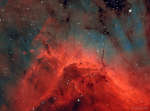 Pillars and Jets in the Pelican Nebula
3.03.2015
What dark structures arise from the Pelican Nebula? Visible as a bird-shaped nebula toward the constellation of a bird (Cygnus, the Swan), the Pelican Nebula is a place dotted with newly formed stars but fouled with dark dust.
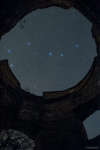 Castle Eye View
7.04.2017
The best known asterism in northern skies, The Big Dipper is easy to recognize, even when viewed upside down, though some might see a plough or wagon. The star names and the familiar outlines...
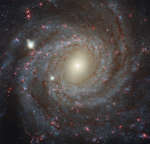 Facing NGC 3344
13.04.2018
From our vantage point in the Milky Way Galaxy, we see NGC 3344 face-on. Nearly 40,000 light-years across, the big, beautiful spiral galaxy is located just 20 million light-years away in the constellation of Leo Minor. This multi-color Hubble Space Telescope close-up of NGC 3344 includes remarkable details from near infrared to ultraviolet wavelengths.
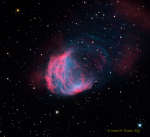 The Medusa Nebula
26.03.2021
Braided and serpentine filaments of glowing gas suggest this nebula's popular name, The Medusa Nebula. Also known as Abell 21, this Medusa is an old planetary nebula some 1,500 light-years away in the constellation Gemini. Like its mythological namesake, the nebula is associated with a dramatic transformation.
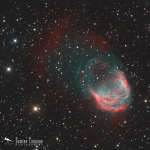 The Medusa Nebula
25.03.2022
Braided and serpentine filaments of glowing gas suggest this nebula's popular name, The Medusa Nebula. Also known as Abell 21, this Medusa is an old planetary nebula some 1,500 light-years away in the constellation Gemini. Like its mythological namesake, the nebula is associated with a dramatic transformation.
 APOD: 2024 February 5 Б In the Core of the Carina Nebula
5.02.2024
What's happening in the core of the Carina Nebula? Stars are forming, dying, and leaving an impressive tapestry of dark dusty filaments. The entire Carina Nebula, cataloged as NGC 3372, spans over 300 light years and lies about 8,500 light-years away in the constellation of Carina.
|
January February March April May June July August September October |
|||||||||||||||||||||||||||||||||||||||||||||||||