
|
You entered: gas
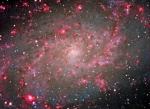 Hydrogen in M33
23.11.2006
Gorgeous spiral galaxy M33 seems to have more than its fair share of hydrogen. Its inner 30,000 light-years are shown here in an image processed to fully reveal the reddish glow of ionized hydrogen regions (HII regions) sprawling along loose spiral arms as they wind toward the galaxy's core.
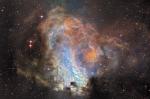 Star Factory Messier 17
10.08.2007
Sculpted by stellar winds and radiation, the star factory known as Messier 17 lies some 5,500 light-years away in the nebula-rich constellation Sagittarius. At that distance, this 30 arcminute field of view spans almost 50 light-years.
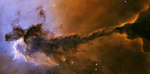 The Fairy of Eagle Nebula
9.12.2007
The dust sculptures of the Eagle Nebula are evaporating. As powerful starlight whittles away these cool cosmic mountains, the statuesque pillars that remain might be imagined as mythical beasts. Pictured above is one of several striking dust pillars of the Eagle Nebula that might be described as a gigantic alien fairy.
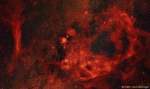 The Gum Nebula
22.08.2009
Named for Australian astronomer Colin Stanley Gum (1924-1960), The Gum Nebula is so large and close it is actually hard to see. In fact, we are only about 450 light-years from the front edge and 1,500 light-years from the back edge of this cosmic cloud of glowing hydrogen gas.
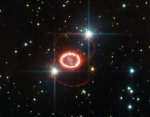 The Mysterious Rings of Supernova 1987A
26.02.2012
What's causing those odd rings in supernova 1987A? Twenty five years ago, in 1987, the brightest supernova in recent history was seen in the Large Magellanic Clouds. At the center of the above picture is an object central to the remains of the violent stellar explosion.
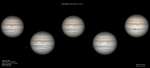 Jupiter and Io
28.11.2012
On December 3 (UT), Jupiter, the solar system's largest planet, will be at opposition, opposite the Sun in planet Earth's sky, shining brightly and rising as the Sun sets. That configuration results in Jupiter's almost annual closest approach to planet Earth.
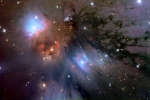 Still Life with Reflecting Dust
4.03.2017
In this beautiful celestial still life composed with a cosmic brush, dusty nebula NGC 2170 shines at the upper left. Reflecting the light of nearby hot stars, NGC 2170 is joined by other bluish reflection nebulae, a compact red emission region, and streamers of obscuring dust against a backdrop of stars.
 A December Winter Night
28.12.2024
Orion seems to come up sideways, climbing over a distant mountain range in this deep skyscape. The wintry scene was captured from southern Poland on the northern hemisphere's long solstice night. Otherwise unseen nebulae hang in the sky, revealed by the camera modified to record red hydrogen-alpha light.
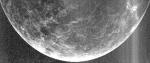 A Radar Image of Venus
15.05.2001
The largest radio telescopes in the world are working together to create a new map of the surface of Venus. The surface of Venus is unusually hidden by a thick atmosphere of mostly carbon dioxide gas. These thick clouds are transparent, however, to radar signals sent and received from Earth.
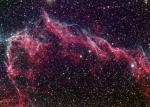 NGC 6992: A Glimpse of the Veil
28.09.2001
After 5,000 years, the gorgeous Veil Nebula is still turning heads. Cataloged as NGC 6992, these glowing filaments of interstellar shocked gas are part of a larger spherical supernova remnant known as the Cygnus Loop or the Veil Nebula -- expanding debris from a star which exploded over 5,000 years ago.
|
January February March April May |
|||||||||||||||||||||||||||||||||||||||||||||||||