
|
You entered: gas
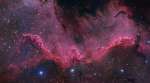 Along the Cygnus Wall
11.03.2015
The W-shaped ridge of emission featured in this vivid skyscape is known as the Cygnus Wall. Part of a larger emission nebula with a distinctive outline popularly called The North America Nebula, the cosmic ridge spans about 20 light-years.
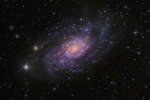 NGC 2403 in Camelopardalis
26.03.2015
Magnificent island universe NGC 2403 stands within the boundaries of the long-necked constellation Camelopardalis. Some 10 million light-years distant and about 50,000 light-years across, the spiral galaxy also seems to have more than its fair share of giant star forming HII regions, marked by the telltale reddish glow of atomic hydrogen gas.
 Star Colors and Pinyon Pine
24.12.2015
Beautiful, luminous decorations on this pinyon pine tree are actually bright stars in the constellation Scorpius and the faint glow of the central Milky Way. Captured in June from the north...
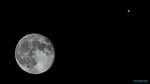 Moons and Jupiter
3.03.2016
Some of the Solar System's largest moons rose together on February 23. On that night, a twilight pairing of a waning gibbous Moon and Jupiter was captured in this sharp telescopic field of view.
 Epsilon Tauri: Star with Planet
26.01.2024
Epsilon Tauri lies 146 light-years away. A K-type red giant star, epsilon Tau is cooler than the Sun, but with about 13 times the solar radius it has nearly 100 times the solar luminosity.
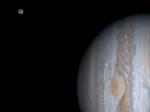 Jupiter, Europa, and Callisto
2.01.2001
As the robot Cassini spacecraft rounds Jupiter on its way toward Saturn, it has taken a sequence of images of the gas giant with its four largest moons. Previously released images have highlighted Ganymede and Io. Pictured above are the two remaining Galilean satellites: Europa and Callisto.
 Three Planets by the Sea
2.07.2005
On Tuesday, June 28th, the setting Sun flooded the horizon with a beautiful warm light in this view from the beach beside the pier at Brighton in Adelaide, South Australia. The Sun also illuminated three planets gathered in the western sky, Mercury, Venus, and Saturn.
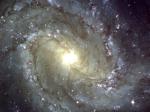 M83: The Southern Pinwheel Galaxy from VLT
18.12.2005
M83 is one of the closest and brightest spiral galaxies on the sky. Visible with binoculars in the constellation of Hydra, majestic spiral arms have prompted its nickname as the Southern Pinwheel. Although discovered...
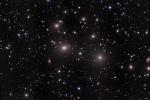 The Perseus Cluster of Galaxies
30.12.2005
Here is one of the largest objects that anyone will ever see on the sky. Each of these fuzzy blobs is a galaxy, together making up the Perseus Cluster, one of the closest clusters of galaxies. The cluster is seen through a foreground of faint stars in our own Milky Way Galaxy.
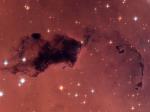 A Dust Cloud in NGC 281
20.04.2006
Stars themselves can create huge and intricate dust sculptures from the dense and dark molecular clouds from which they are born. The tools the stars use to carve their detailed works are high energy light and fast stellar winds.
|
January February March April May |
|||||||||||||||||||||||||||||||||||||||||||||||||