
|
You entered: dark
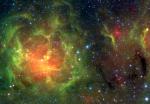 Infrared Trifid
13.01.2005
The Trifid Nebula, aka M20, is easy to find with a small telescope, a well known stop in the nebula rich constellation Sagittarius. But where visible light pictures show the nebula divided into three parts by dark, obscuring dust lanes, this penetrating infrared image reveals filaments of luminous gas and newborn stars.
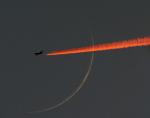 When the Moon Was Young
13.05.2005
Remember when the Moon was young? It was just last Monday. On May 9th, this slender crescent Moon was recorded at a tender age of 34 hours and 18 minutes. Well, OK ... when calculating...
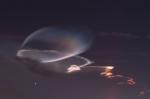 A Rocket Launch at Sunset
28.09.2005
What kind of cloud is that? Last week, a sunset rocket launch lit up the sky and was photographed by sky enthusiasts as far as hundreds of miles away. The lingering result was a photogenic rocket plume.
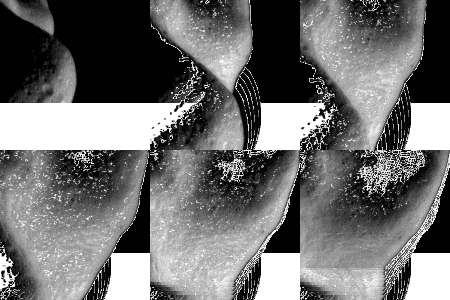 Flying Over Asteroid Eros
27.03.2000
What would it look like to fly over an asteroid? Spacecraft NEAR Shoemaker in orbit around asteroid 433 Eros found out earlier this month when it recorded its first fly-over sequence. The saddle region of the Sun-orbiting space-mountain appears to zip past the camera in this condensed hour-long time-lapse sequence.
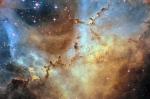 Dust Sculptures in the Rosette Nebula
6.06.2007
What creates the cosmic dust sculptures in the Rosette Nebula? Noted for the common beauty of its overall shape, parts of the Rosette Nebula, also known as NGC 2244, show beauty even when viewed up close.
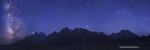 A Spectacular Sky Over the Grand Tetons
14.08.2007
Behold the breathtaking beauty of Earth and sky together. In the foreground is the Teton Mountain Range of Wyoming, USA. The Grand Tetons are a relatively isolated set of high peaks that are part of the Rocky Mountains.
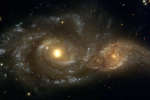 Spiral Galaxies in Collision
20.04.2008
Billions of years from now, only one of these two galaxies will remain. Until then, spiral galaxies NGC 2207 and IC 2163 will slowly pull each other apart, creating tides of matter, sheets of shocked gas, lanes of dark dust, bursts of star formation, and streams of cast-away stars.
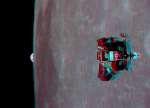 The Eagle Rises
10.08.2008
Get out your red/blue glasses and check out this remarkable stereo view from lunar orbit. Created from two photographs (AS11-44-6633, AS11-44-6634) taken by astronaut Michael Collins during the 1969 Apollo 11 mission, the 3D anaglyph features the lunar module ascent stage, dubbed The Eagle, as it rises to meet the command module in lunar orbit.
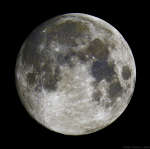 On a Blue Moon
1.09.2012
Rising at sunset, the gorgeous Full Moon of August 31 became the second Full Moon in a month. According to modern reckoning, that makes it a Blue Moon. In fact, parts of the Full Moon do look a little blue in this sharp lunar portrait.
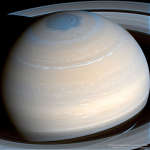 Saturn in Infrared from Cassini
3.04.2017
Many details of Saturn appear clearly in infrared light. Bands of clouds show great structure, including long stretching storms. Also quite striking in infrared is the unusual hexagonal cloud pattern surrounding Saturn's North Pole. Each side of the dark hexagon spans roughly the width of our Earth.
|
January February March April May June July August September |
|||||||||||||||||||||||||||||||||||||||||||||||||