
|
You entered: space
 APOD: 2023 April 8 Б M100: A Grand Design Spiral Galaxy
8.04.2023
Majestic on a truly cosmic scale, M100 is appropriately known as a grand design spiral galaxy. It is a large galaxy of over 100 billion stars with well-defined spiral arms that is similar to our own Milky Way Galaxy.
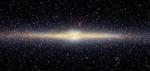 The Milky Way in Infrared
29.12.1997
At night, from a dark location, part of the clear sky looks milky. This unusual swath of dim light is generally visible during any month and from any location. Until the invention of the telescope, nobody really knew what the "Milky Way" was.
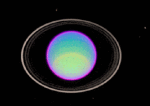 Uranus' Ring System
30.04.1996
The rings of Uranus are thin, narrow, and dark compared to other planetary ring systems. Brightened artificially by computer, the ring particles reflect as little light as charcoal, although they are really made of ice chucks darkened by rock.
 In the Center of the Whirlpool
25.04.1996
In the center of M51, a spiral galaxy 23 million light-years away, astronomers have identified a dense region of young stars. The graceful swirling arcs of this galaxy's spiral arms have inspired its popular name, "The Whirlpool Galaxy".
 APOD Turns Eight
16.06.2003
The first APOD appeared eight years ago today, on 1995 June 16. To date, we estimate that APOD has now served over 100 million space-related images. We again thank our readers and NASA...
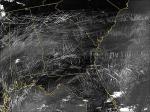 Contrail Clutter over Georgia
13.10.2004
Artificial clouds made by humans may become so common they change the Earth's climate. The long thin cloud streaks that dominate the above satellite photograph of Georgia are contrails, cirrus clouds created by airplanes. The exhaust of an airplane engine can create a contrail by saturating the surrounding air with extra moisture.
 R136: The Massive Stars of 30 Doradus
11.12.2005
In the center of star-forming region 30 Doradus lies a huge cluster of the largest, hottest, most massive stars known. These stars, known as the star cluster R136, and part of the surrounding nebula are captured here in this gorgeous visible-light image from the Hubble Space Telescope.
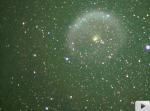 A Rocket Debris Cloud Drifts
26.02.2007
What's that cloud drifting in space? It's not an astronomical nebula -- those appear to stay put. Atmospheric clouds don't look like this. The answer to last week's sky mystery turned out to be orbiting and expanding debris from the upper stage of a failed Russian rocket that exploded unexpectedly.
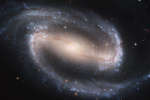 Barred Spiral Galaxy NGC 1300
22.06.2008
Big, beautiful, barred spiral galaxy NGC 1300 lies some 70 million light-years away on the banks of the constellation Eridanus. This Hubble Space Telescope composite view of the gorgeous island universe is one of the largest Hubble images ever made of a complete galaxy.
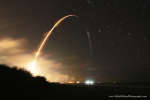 A Launch and a Landing
27.09.2014
Taken from an Atlantic beach, Cape Canaveral, planet Earth, four identically framed digital images are combined in this night skyscape. Slightly shifted short star trails dot the sky, but the exposure times were adjusted to follow the flight of a Falcon 9 rocket.
|
January February March April May June July August September |
|||||||||||||||||||||||||||||||||||||||||||||||||