
|
You entered: space
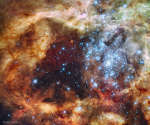 Star Cluster R136 Bursts Out
23.01.2016
In the center of star-forming region 30 Doradus lies a huge cluster containing some of the largest, hottest, and most massive stars known. These stars, known collectively as star cluster R136, were captured in the featured image in visible light by the Wide Field Camera 3 in 2009 peering through the Hubble Space Telescope.
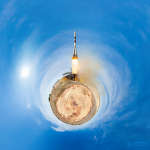 Little Planet Soyuz
14.06.2018
Engines blazing, a large rocket bids farewell to this little planet. Of course, the little planet is really planet Earth and the large rocket is a Soyuz-FG rocket. Launched from the Baikonur Cosmodrome in Kazakhstan on June 6 it carried a Soyuz MS-09 spacecraft into orbit.
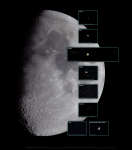 One Night One Telescope One Camera
27.07.2018
Taken on the same night, from the same place, with the same telescope and camera, these postcards from our Solar System are shown at the same scale to provide an interesting comparison of apparent sizes. Spanning about half a degree in planet Earth's sky, the Moon is a stitched mosaic of six images.
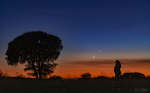 Venus and Jupiter on the Horizon
25.11.2019
What are those two bright objects on the horizon? Venus and Jupiter. The two brightest planets in the night sky passed very close together -- angularly -- just two days ago. In real space, they were...
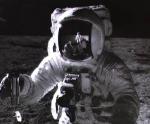 Apollo 12: Self-Portrait
3.11.2000
Is it art? In November of 1969, Apollo 12 astronaut-photographer Charles "Pete" Conrad recorded this masterpiece while documenting colleague Alan Bean's lunar soil collection activities on the Oceanus Procellarum. The image is dramatic and stark. Bean is faceless.
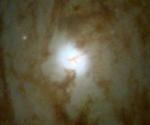 M51: The Center Of The Whirlpool
27.05.2000
In the center of M51, a spiral galaxy 23 million light-years away, astronomers have identified a dense region of young stars. Viewed face-on in the constellation Canes Venatici, the swirling arcs of this galaxy's spiral arms have inspired its popular name, The Whirlpool Galaxy.
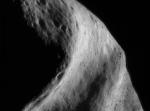 The Past of Asteroid Eros
9.10.2001
How did large rocks come to be scattered on the surface of asteroid Eros? Eros stands out not only because of its proximity to Earth but also because it was visited recently by NASA's NEAR-Shoemaker spacecraft.
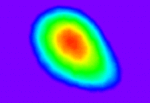 Painting with Solar Neutrons
24.10.1995
Solar flares are propelled high above the Sun's surface by powerful, twisted magnetic fields. The flares spew high energy atomic and subatomic particles into space. During an intense solar flare on June 15, 1991, a spray of solar neutrons was detected by the COMPTEL instrument onboard NASA's Compton Gamma Ray Observatory.
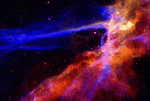 Rampaging Fronts of the Veil Nebula
6.03.1996
A supernova explosion of a high-mass star results in fast moving blast waves. At the front of the waves shown above, ionized gas in the Veil Supernova Remnant rushes out from the explosion, sweeps up material, and breaks up many atoms into constituent ions and electrons.
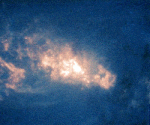 In the Center of Spiral M77
11.09.1996
What is happening in the center of nearby spiral galaxy M77? To find out, astronomers used the Hubble Space Telescope to peer deep into the dusty chaos of this active galactic nucleus in 1994.
|
January February March April May June July August September |
|||||||||||||||||||||||||||||||||||||||||||||||||