
|
You entered: star
 APOD: 2024 September 29 Б Seven Dusty Sisters
29.09.2024
Is this really the famous Pleiades star cluster? Known for its iconic blue stars, the Pleiades is shown here in infrared light where the surrounding dust outshines the stars. Here, three infrared colors have been mapped into visual colors (R=24, G=12, B=4.6 microns).
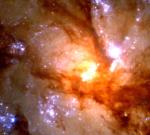 Closeup of Antennae Galaxy Collision
27.10.1997
It's a clash of the titans. Two galaxies are squaring off in Corvus and here are the latest pictures. When two galaxies collide, however, the stars that compose them usually do not. This is because galaxies are mostly empty space and, however bright, stars only take up only a small amount of that space.
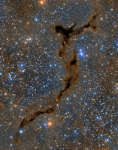 Dark Seahorse in Cepheus
24.10.2019
Light-years across, this suggestive shape known as the Seahorse Nebula appears in silhouette against a rich, luminous background of stars. Seen toward the royal northern constellation of Cepheus, the dusty, obscuring clouds are part of a Milky Way molecular cloud some 1,200 light-years distant.
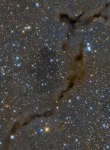 The Dark Seahorse in Cepheus
5.11.2021
Light-years across, this suggestive shape known as the Seahorse Nebula appears in silhouette against a rich, luminous background of stars. Seen toward the royal northern constellation of Cepheus, the dusty, obscuring clouds are part of a Milky Way molecular cloud some 1,200 light-years distant.
 The Dark Seahorse in Cepheus
20.04.2023
Spanning light-years, this suggestive shape known as the Seahorse Nebula appears in silhouette against a rich, luminous background of stars. Seen toward the royal northern constellation of Cepheus, the dusty, obscuring clouds are part of a Milky Way molecular cloud some 1,200 light-years distant.
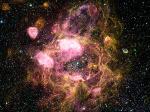 N11: A Giant Ring of Emission Nebulas
6.10.2004
How did this unusually large nebula form? One of the largest nebulas yet detected is actually a complex ring of emission nebulas connected by glowing filaments. The unusual network, known as N11, spans over...
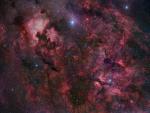 Northern Cygnus
20.09.2007
Bright, hot, supergiant star Deneb lies at top center in this gorgeous skyscape. The 20 frame mosaic spans an impressive 12 degrees across the northern end of Cygnus the Swan. Crowded with stars...
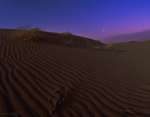 Brighter Than Mars
27.08.2010
Even though you may have just read an email claiming Mars will be incredibly bright tonight, the brightest star on the horizon is not Mars. From central Iran on August 24th, the brightest star in this twilight desert skyview is Venus, aka the Evening Star.
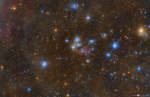 NGC 2170: Celestial Still Life
6.03.2012
Is this a painting or a photograph? In this beautiful celestial still life composed with a cosmic brush, dusty nebula NGC 2170 shines near the image center. Reflecting the light of nearby hot stars...
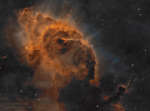 HH 666: Carina Dust Pillar with Jet
6.12.2017
To some, it may look like a beehive harboring an evil bee. In reality, the featured Hubble image captures a cosmic pillar of dust, two-light years long, inside of which is Herbig-Haro 666 -- a young star emitting powerful jets.
|
January February March April May June July August September |
|||||||||||||||||||||||||||||||||||||||||||||||||