
|
You entered: star
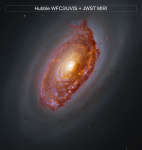 APOD: 2026 September 16 Б Webb's View of M64
16.09.2026
Sometimes where Hubble finds darkness, Webb sees light. An example is todayБs composite images of Messier 64 (M64), a nearby spiral galaxy of many names. The dark band of dust partially blocking its bright core earned it the moniker Бthe Black Eye Galaxy.
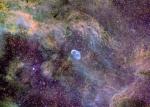 NGC 6888: A Tricolor Starfield
6.07.2006
NGC 6888, also known as the Crescent Nebula, is a cosmic bubble about 25 light-years across, blown by winds from its central, bright, massive star. Near the center of this intriguing widefield view of interstellar gas clouds and rich star fields of the constellation Cygnus, NGC 6888 is about 5,000 light-years away.
 The Great Globular Cluster in Hercules
26.09.2024
In 1716, English astronomer Edmond Halley noted, "This is but a little Patch, but it shows itself to the naked Eye, when the Sky is serene and the Moon absent." Of course...
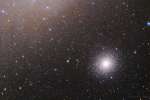 47 Tuc Near the Small Magellanic Cloud
6.12.2012
Globular star cluster 47 Tucanae is a jewel of the southern sky. Also known as NGC 104, it roams the halo of our Milky Way Galaxy along with around 200 other globular star clusters.
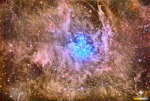 The Pleiades Deep and Dusty
14.11.2017
The well-known Pleiades star cluster is slowly destroying part of a passing cloud of gas and dust. The Pleiades is the brightest open cluster of stars on Earth's sky and can be seen from almost any northerly location with the unaided eye.
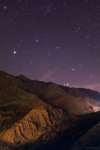 Regulus and the Red Planet
10.06.2010
Leo's royal star Regulus and red planet Mars appear in a colorful pairing just above the horizon in this starry skyscape. The photo was taken on June 4th from Oraman, a mountainous region of Kurdistan in western Iran near the border with Iraq.
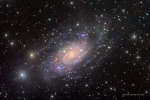 NGC 2403 in Camelopardalis
19.02.2016
Magnificent island universe NGC 2403 stands within the boundaries of the long-necked constellation Camelopardalis. Some 10 million light-years distant and about 50,000 light-years across, the spiral galaxy also seems to have more than its fair share of giant star forming HII regions, marked by the telltale reddish glow of atomic hydrogen gas.
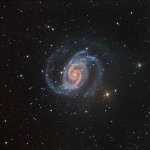 NGC 1566: The Spanish Dancer Spiral Galaxy
14.01.2022
An island universe of billions of stars, NGC 1566 lies about 60 million light-years away in the southern constellation Dorado. Popularly known as the Spanish Dancer galaxy, it's seen face-on from our Milky Way perspective.
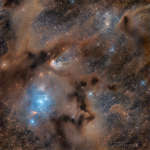 Chamaeleon I Molecular Cloud
17.02.2022
Dark markings and bright nebulae in this telescopic southern sky view are telltale signs of young stars and active star formation. They lie a mere 650 light-years away, at the boundary of the local bubble and the Chamaeleon molecular cloud complex.
 Recurrent Nova RS Ophiuci
24.02.2006
This pretty star field in the constellation Ophiucus is centered on a star not often seen - RS Ophiuci. In fact, early last week RS Oph suddenly became visible to the naked eye for the first time since 1985.
|
January February March April May June July August September |
|||||||||||||||||||||||||||||||||||||||||||||||||