
|
You entered: ionization region
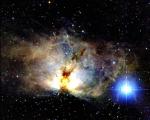 The Flame Nebula in Infrared
13.07.1999
What lights up the Flame Nebula? Fifteen hundred light years away towards the constellation of Orion lies a nebula which, from its glow and dark dust lanes, appears like a billowing fire. But fire, the rapid acquisition of oxygen, is not what makes this Flame glow.
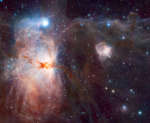 The Flame Nebula in Infrared
11.01.2010
What lights up the Flame Nebula? Fifteen hundred light years away towards the constellation of Orion lies a nebula which, from its glow and dark dust lanes, appears, on the left, like a billowing fire. But fire, the rapid acquisition of oxygen, is not what makes this Flame glow.
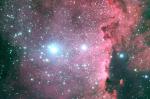 Hot Stars in the Southern Milky Way
7.05.1999
Hot blue stars, red glowing hydrogen gas, and dark, obscuring dust clouds are strewn through this dramatic region of the Milky Way in the southern constellation of Ara (the Altar). About 4,000 light-years from Earth, the stars at the left are young, massive, and energetic.
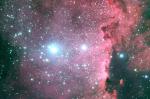 Hot Stars in the Southern Milky Way
21.12.2001
Hot blue stars, red glowing hydrogen gas, and dark, obscuring dust clouds are strewn through this dramatic region of the Milky Way in the southern constellation of Ara (the Altar). About 4,000 light-years from Earth, the stars at the left are young, massive, and energetic.
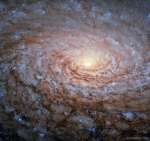 M63: The Sunflower Galaxy from Hubble
8.11.2016
One of the bright spiral galaxies visible in the north sky is M63, the Sunflower Galaxy. M63, also catalogued as NGC 5055, can be found with a small telescope toward the constellation of Hunting Dogs (Canes Venatici).
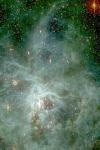 In the Heart of the Tarantula Nebula
27.10.1999
In the heart of monstrous Tarantula Nebula lies one of the most unusual star clusters. Known as NGC 2070 or R136, it is home to a great number of hot young stars. The energetic light from these stars continually ionizes nebula gas, while their energetic particle wind blows bubbles and defines intricate filaments.
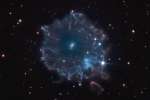 Halo of the Cat s Eye
31.08.2012
The Cat's Eye Nebula (NGC 6543) is one of the best known planetary nebulae in the sky. Its haunting symmetries are seen in the very central region of this tantalizing image, processed to reveal the enormous but extremely faint halo of gaseous material, about 6 light-years across, which surrounds the brighter, familiar planetary nebula.
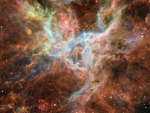 In the Heart of the Tarantula Nebula
31.03.2009
In the heart of monstrous Tarantula Nebula lies huge bubbles of energetic gas, long filaments of dark dust, and unusually massive stars. In the center of this heart, is a knot of stars so dense that it was once thought to be a single star.
 APOD: 2024 June 10 Б Sh2 132: The Lion Nebula
9.06.2024
Is the Lion Nebula the real ruler of the constellation Cepheus? This powerful feline appearing nebula is powered by two massive stars, each with a mass over 20 times greater than our Sun. Formed...
 Gamma Cas and Friends
23.12.2009
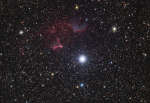
Gamma Cassiopeiae shines high in northern autumn evening skies. The brightest spiky star in this rich and colorful Milky Way starfield, bluish Gamma Cas marks the central peak in the W-shaped constellation Cassiopeia.
|
January February March April May June July August |
||||||||||||||||||||||||||||||||||||||||||||||||||||||||