
|
You entered: image
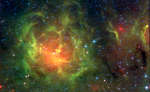 Infrared Trifid
24.07.2015
The Trifid Nebula, also known as Messier 20, is easy to find with a small telescope, a well known stop in the nebula rich constellation Sagittarius. But where visible light pictures show the nebula...
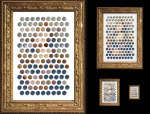 The Moona Lisa
15.10.2021
Only natural colors of the Moon in planet Earth's sky appear in this creative visual presentation. Arranged as pixels in a framed image, the lunar disks were photographed at different times. Their varying hues are ultimately due to reflected sunlight affected by changing atmospheric conditions and the alignment geometry of Moon, Earth, and Sun.
 The Moona Lisa
13.09.2024
Only natural colors of the Moon in planet Earth's sky appear in this creative visual presentation. Arranged as pixels in a framed image, the lunar disks were photographed at different times. Their varying hues are ultimately due to reflected sunlight affected by changing atmospheric conditions and the alignment geometry of Moon, Earth, and Sun.
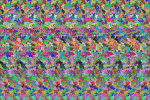 The Holographic Principle
13.09.2009
Is this picture worth a thousand words? According to the Holographic Principle, the most information you can get from this image is about 3 x 10 65 bits for a normal sized computer monitor.
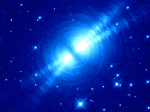 Searchlight Beams from the Egg Nebula
28.01.1996
The dramatic and mysterious looking object revealed in this Hubble Space Telescope image is known as the Egg Nebula. It is an aging star about 3,000 lightyears distant, entering its Planetary Nebula phase of evolution.
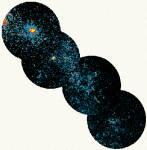 The UV SMC from UIT
19.12.1996
Translated from the "acronese" the title reads - The UltraViolet Small Magellanic Cloud from the Ultraviolet Imaging Telescope. FYI, the four ultraviolet images used in this mosaic of the nearby irregular galaxy known...
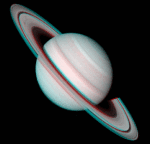 Stereo Saturn
11.02.2000
Get out your red/blue glasses and launch yourself into this stereo picture of Saturn! The picture is actually composed from two images recorded weeks apart by the Voyager 2 spacecraft during its visit to the Saturnian System in August of 1981.
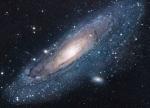 M31: The Andromeda Galaxy
18.07.2004
Andromeda is the nearest major galaxy to our own Milky Way Galaxy. Our Galaxy is thought to look much like Andromeda. Together these two galaxies dominate the Local Group of galaxies. The diffuse light from Andromeda is caused by the hundreds of billions of stars that compose it.
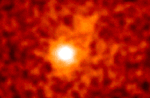 Gamma Ray Quasar
25.12.1998
The bright object in the center of the false color image above is quasar 3C279 viewed in gamma-rays, photons with more than 40 million times the energy of visible light. Like all quasars, 3C279 is a nondescript, faint, star-like object in the visible sky.
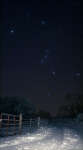 Sideways Orion Over Snowy Ireland
25.12.2010
Orion always comes up sideways ... and was caught in the act earlier this month by over a snowy landscape in Donegal, Ireland. To compose this serene picture, the photographer found a picturesque setting to the east, waited until after sunset, and then momentarily lit the foreground with a flashlight.
|
January February March April May June July August September |
|||||||||||||||||||||||||||||||||||||||||||||||||