
|
You entered: image
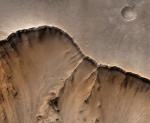 Mars: A Canyon's Edge
19.03.1998
High resolution Mars Global Surveyor images were combined with Viking Orbiter color data to produce this stunning, detailed view of a Martian canyon's edge. The area pictured is about 6 miles wide and represents a tiny part of the northern edge of the canyon Valles Marineris, whose total length is about 2,500 miles.
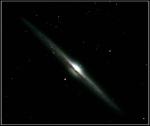 NGC 4565: Needle Galaxy
17.06.1999
Presenting a sleek needle-like profile the magnificent spiral galaxy NGC 4565 is viewed edge-on from planet Earth. Its core of stars bulges from the centre of a thin disk of spiral arms and dust. The core appears to be cut sharply by dust lanes to dramatic effect in this composite image.
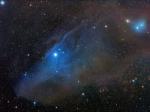 Horse Head Shaped Reflection Nebula IC 4592
8.08.2006
Do you see the horse's head? What you are seeing is not the famous Horsehead nebula toward Orion but rather a fainter nebula that only takes on a familiar form with deeper imaging. The main part of the above imaged molecular cloud complex is a reflection nebula cataloged as IC 4592.
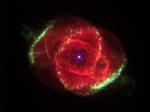 The Cats Eye Nebula
12.11.2006
Three thousand light-years away, a dying star throws off shells of glowing gas. This image from the Hubble Space Telescope reveals the Cat's Eye Nebula to be one of the most complex planetary nebulae known.
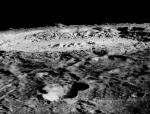 Lunar Orbiter Views Crater Copernicus
16.06.2007
To prepare for the Apollo landings, five Lunar Orbiter spacecraft were launched during 1966 and 1967 to gather detailed images of our fair planet's large, natural satellite. Dramatic views returned by the spacecraft cameras included this stark moonscape.
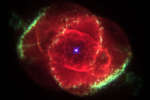 The Cats Eye Nebula
27.12.2009
Three thousand light-years away, a dying star throws off shells of glowing gas. This image from the Hubble Space Telescope reveals the Cat's Eye Nebula to be one of the most complex planetary nebulae known.
 La Palma Eclipse Sequence
7.10.2015
At left, a dramatic image sequence follows late September's total lunar eclipse above a rugged landscape and sea of clouds from the Canary island of La Palma. Composited in a circular fisheye projection...
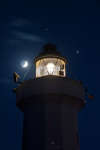 Great Conjunction over Sicilian Lighthouse
8.12.2020
DonБt miss the coming great conjunction. In just under two weeks, the two largest planets in our Solar System will angularly pass so close together in Earth's sky that the Moon would easily be able to cover them both simultaneously. This pending planetary passage -- on December 21 -- will be the closest since 1623.
 Young Stars, Stellar Jets
28.07.2023
High-speed outflows of molecular gas from a pair of actively forming young stars shine in infrared light, revealing themselves in this NIRcam image from the James Webb Space Telescope. Cataloged as HH (Herbig-Haro) 46/47, the young stars are lodged within a dark nebula that is largely opaque when viewed in visible light.
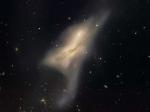 The Colliding Galaxies of NGC 520
12.09.2005
Is this one galaxy or two? The jumble of stars, gas, and dust that is NGC 520 is now thought to incorporate the remains of two separate galaxies. A combination of observations and simulations indicate the NGC 520 is actually the collision of two disk galaxies.
|
January February March April May June July August September |
|||||||||||||||||||||||||||||||||||||||||||||||||