
|
You entered: Earth
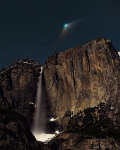 APOD: 2023 February 21 Б Comet ZTF over Yosemite Falls
20.02.2023
They are both falling. The water in Yosemite Falls, California, USA, is falling toward the Earth. Comet ZTF is falling toward the Sun. This double cosmic cascade was captured late last month as fading Comet C/2022 E3 (ZTF) had just passed its closest to planet Earth. The orange star just over the falls is Kochab.
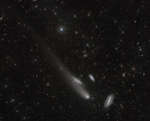 Three Galaxies and a Comet
20.12.2023
Distant galaxies abound in this one degree wide field of view toward the southern constellation Grus (The Crane). But the three spiral galaxies at the lower right are quite striking. In fact, all three galaxies are grouped about 70 million light years away and sometimes known as the Grus Triplet.
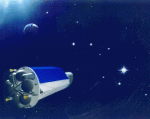 Searching For Solar Systems
14.11.1996
Observational astronomy has recently provided evidence of the existence of massive Jupiter-sized planets orbiting distant suns, protoplanetary disks of gas and dust surrounding newly formed stars, and planetary bodies orbiting exotic stellar corpses known as pulsars. Indeed, the formation of planets seems to be a broader and more varied phenomenon than previously imagined.
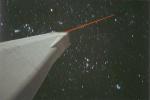 Space Laser Creates Artificial Star
25.04.2001
Some astronomers don't like stars. Bright star fluctuations can indicate how the Earth's atmosphere is changing, but many times no bright star exists in the direction where atmospheric information is needed.
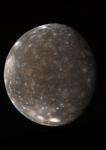 Oceans Under Jupiters Callisto
31.07.2001
Why does Jupiter's moon Callisto alter the magnetic field of Jupiter in its vicinity? Callisto itself does not have a strong magnetic field. One possible answer is that Callisto harbors sub-surface oceans of electrically conducting salt-water. This hypothesis was bolstered recently by a new analysis of how Callisto creates and dissipates heat.
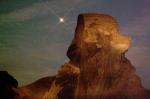 Mars Rising Behind Poodle Rock
13.08.2003
Have you seen Mars lately? As Earth and Mars near their closest approach in nearly 60,000 years on August 27, the red planet has begun to appear dramatically bright and show interesting details through telescopes and binoculars. Although not yet visible at sunset, Mars can be seen rising increasingly earlier in the evening.
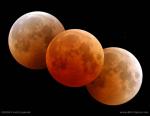 Red Moon Triple
29.10.2004
Some thought of baseball and some thought of Halloween during October 27th's widely viewed total lunar eclipse. Sliding through Earth's shadow, the Moon turned haunting shades of red and orange during the eclipse's total phase.
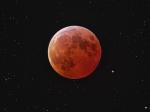 Eclipsed Moon and Stars
7.03.2007
This dramatic image features a dark red Moon during a total lunar eclipse -- celestial shadow play enjoyed by many denizens of planet Earth last Saturday. Recorded near Wildon, Austria, the picture is a composite...
 Vesta Rocks
10.12.2011
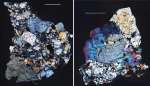
These colorful images are of thin slices of meteorites viewed through a polarizing microscope. Part of the group classified as HED meteorites for their mineral content (Howardite, Eucrite, Diogenite), they likely fell to Earth from 4 Vesta, the mainbelt asteroid currently being explored by NASA's Dawn spacecraft.
 Jupiter, Ganymede, Great Red Spot
14.05.2015
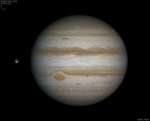
In this sharp snapshot, the Solar System's largest moon Ganymede poses next to Jupiter, the largest planet. Captured on March 10 with a small telescope from our fair planet Earth, the scene also includes Jupiter's Great Red Spot, the Solar System's largest storm.
|
January February March April May June July August September October |
|||||||||||||||||||||||||||||||||||||||||||||||||