
|
You entered: Earth
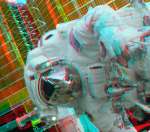 Take My Hand
18.09.2009
Get out your red/blue glasses and check out this close-up of spacesuited NASA astronaut John Olivas outside the International Space Station. Carefully constructed from two photographs (ISS020-E-038481, ISS02-0E-038482) taken during space shuttle orbiter Discovery...
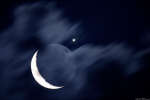 Moon Meets Jupiter
20.07.2012
Skygazers around planet Earth enjoyed the close encounter of planets and Moon in July 15's predawn skies. And while many saw bright Jupiter next to the slender, waning crescent, Europeans also...
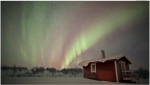 Trees, Stars, Aurora
9.02.2012
Have you ever seen an aurora? Auroras are occurring again with increasing frequency. With the Sun being unusually dormant over the past four years, the amount of Sun-induced auroras has been unusually low. More recently, however, our Sun has become increasingly active and exhibiting a greater abundance of sunspots, flares, and coronal mass ejections.
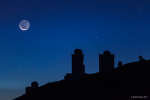 Mercury and the Da Vinci Glow
10.07.2021
On July 8th early morning risers saw Mercury near an old Moon low on the eastern horizon. On that date bright planet, faint glow of lunar night side, and sunlit crescent were captured in this predawn skyscape from Tenerife's Teide National Park in the Canary Islands.
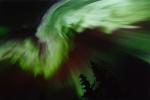 Aurora Alaskan Style
29.03.2001
Have you checked the space weather report lately? With a coronal mass ejection (CME) headed our way and an immense sunspot group tracking across the solar photosphere, skygazers should be on the alert.
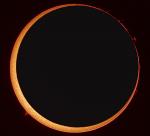 An Annular Solar Eclipse at High Resolution
5.10.2005
On Monday, part of the Sun went missing. The missing piece was no cause for concern -- the Moon was only momentarily in the way. The event was not a total eclipse of the Sun for any Earth-bound sky enthusiast but rather, at best, an annular eclipse, where the Moon blocked most of the Sun.
 Juno Rockets Toward Jupiter
9.08.2011
Next stop: Jupiter. Last week included one of the few times in history that humanity launched something completely off the Earth, moving away so fast that it will never return. Well, almost -- Juno...
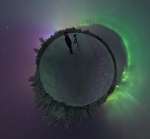 Planet Aurora Borealis
28.01.2012
Illuminated by an eerie greenish light, this remarkable little planet is covered with ice and snow and ringed by tall pine trees. Of course, this little planet is actually planet Earth, and the surrounding stars are above the horizon near Östersund, Sweden.
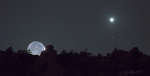 Earthshine and Venus Over Sierra de Guadarrama
28.03.2012
What just above that ridge? The Moon. Specifically, the Earth's Moon was caught just above the horizon in a young crescent phase. The familiar Moon might look a bit odd as the exposure shows significant Earthshine -- the illumination of the part of the Moon hidden from direct sunlight by the sun-reflecting Earth.
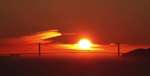 Golden Gate Sunset: Green Flash
2.12.2015
The setting is San Francisco Bay, the time is sunset, and the bridge is the Golden Gate. What you are about to see is an unexpected double sunset ending with a rare green flash.
|
January February March April May June July August September October |
|||||||||||||||||||||||||||||||||||||||||||||||||