
|
You entered: nebula
 Star Factory Messier 17
28.08.2024
A nearby star factory known as Messier 17 lies some 5,500 light-years away in the nebula-rich constellation Sagittarius. At that distance, this 1.5 degree wide field-of-view would span about 150 light-years.
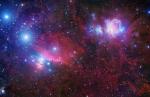 The Orion Deep Field
5.01.2007
Adrift 1,500 light-years away in one of the night sky's most recognizable constellations, the glowing Orion Nebula and the dark Horsehead Nebula are contrasting cosmic vistas. But even fainter filaments of glowing...
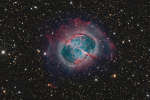 M27: Not a Comet
28.08.2019
While hunting for comets in the skies above 18th century France, astronomer Charles Messier diligently kept a list of the things he encountered that were definitely not comets. This is number 27 on his now famous not-a-comet list.
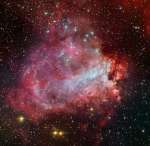 Star Factory Messier 17
21.10.2015
Sculpted by stellar winds and radiation, the star factory known as Messier 17 lies some 5,500 light-years away in the nebula-rich constellation Sagittarius. At that distance, this 1/3 degree wide field of view spans over 30 light-years.
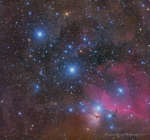 Alnitak, Alnilam, Mintaka
22.11.2017
Alnitak, Alnilam, and Mintaka, are the bright bluish stars from east to west (lower right to upper left) along the diagonal in this cosmic vista. Otherwise known as the Belt of Orion, these three blue supergiant stars are hotter and much more massive than the Sun.
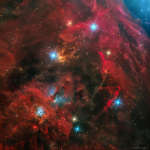 Arcs, Jets, and Shocks near NGC 1999
6.03.2018
This tantalizing array of nebulas and stars can be found about two degrees south of the famous star-forming Orion Nebula. The region abounds with energetic young stars producing jets and outflows that push through the surrounding material at speeds of hundreds of kilometers per second.
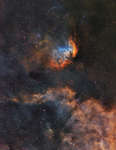 The Tulip and Cygnus X 1
28.07.2021
This tall telescopic field of view looks out along the plane of our Milky Way Galaxy toward the nebula rich constellation Cygnus the Swan. Popularly called the Tulip Nebula, the brightest glowing cloud of interstellar gas and dust above center is also found in the 1959 catalog by astronomer Stewart Sharpless as Sh2-101.
 Chasing Carina
25.02.2010
A jewel of the southern sky, the Great Carina Nebula, aka NGC 3372, spans over 300 light-years. Near the upper right of this expansive skycape, it is much larger than the more northerly Orion Nebula.
 Trapezium: At the Heart of Orion
4.01.2024
Near the center of this sharp cosmic portrait, at the heart of the Orion Nebula, are four hot, massive stars known as the Trapezium. Gathered within a region about 1.5 light-years in radius, they dominate the core of the dense Orion Nebula Star Cluster.
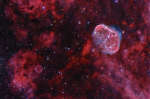 Cygnus: Bubble and Crescent
3.12.2015
These clouds of gas and dust drift through rich star fields along the plane of our Milky Way Galaxy toward the high flying constellation Cygnus. Caught within the telescopic field of view are the Soap Bubble (lower left) and the Crescent Nebula (upper right).
|
January February March April May |
|||||||||||||||||||||||||||||||||||||||||||||||||