
|
You entered: nebula
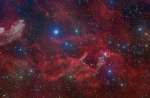 NGC 1788 and the Witch s Whiskers
19.04.2013
This skyscape finds an esthetic balance of interstellar dust and gas residing in the suburbs of the nebula rich constellation of Orion. Reflecting the light of bright star Rigel, Beta Orionis, the jutting, bluish chin of the Witch Head Nebula is at the upper left.
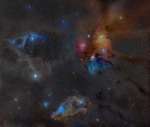 Rho Ophiuchus Wide Field
24.05.2010
The clouds surrounding the star system Rho Ophiucus compose one of the closest star forming regions. Rho Ophiucus itself is a binary star system visible in the light-colored region on the image right.
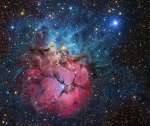 A Beautiful Trifid
13.05.2011
The beautiful Trifid Nebula is a cosmic study in colorful contrasts. Also known as M20, it lies about 5,000 light-years away toward the nebula rich constellation Sagittarius. A star forming region...
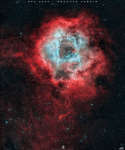 Roses are Red
13.02.2026
Roses are red, nebulas are too, and this Valentine's gift is a stunning view! Pictured is a loving look at the Rosette Nebula (NGC 2237): a cosmic bloom of bright young stars sitting atop a stem of glowing hot gas.
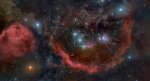 Orion: Head to Toe
23.10.2010
Cradled in cosmic dust and glowing hydrogen, stellar nurseries in Orion the Hunter lie at the edge of a giant molecular cloud some 1,500 light-years away. Spanning nearly 25 degrees, this breath-taking vista stretches across the well-known constellation from head to toe (left to right).
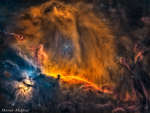 A Lion in Orion
6.03.2022
Yes, but can you see the lion? A deep exposure shows the famous dark indentation that looks like a horse's head, visible just left and below center, and known unsurprisingly as the Horsehead Nebula. The Horsehead Nebula (Barnard 33) is part of a vast complex of dark absorbing dust and bright glowing gas.
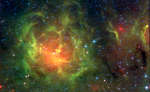 Infrared Trifid
24.07.2015
The Trifid Nebula, also known as Messier 20, is easy to find with a small telescope, a well known stop in the nebula rich constellation Sagittarius. But where visible light pictures show the nebula...
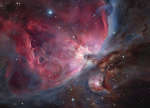 At the Heart of Orion
1.01.2015
Near the center of this sharp cosmic portrait, at the heart of the Orion Nebula, are four hot, massive stars known as the Trapezium. Tightly gathered within a region about 1.5 light-years in radius, they dominate the core of the dense Orion Nebula Star Cluster.
 The Clouds of Orion the Hunter
15.03.2015
Cradled in cosmic dust and glowing hydrogen, stellar nurseries in Orion the Hunter lie at the edge of giant molecular clouds some 1,500 light-years away. Spanning about 30 degrees, this breath-taking vista stretches across the well-known constellation from head to toe (left to right) and beyond.
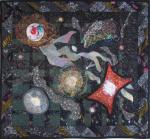 What the Hubble Saw
24.11.2004
In this striking 41 inch by 38 inch quilt, astronomy enthusiast Judy Ross has interpreted some of the Hubble Space Telescope's best galactic and extragalactic vistas. Featured in past APODs, clockwise from...
|
January February March April May |
|||||||||||||||||||||||||||||||||||||||||||||||||