
|
You entered: optical
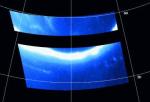 An Auroral Ring on Jupiter
9.06.1997
Do other planets have aurora? Terrestrial and spacecraft observations have found evidence for aurora on Venus, Mars, Jupiter, Saturn, Uranus, and Neptune. In the above false-color photograph, a good portion of an auroral ring was captured recently in optical light by the Galileo spacecraft in orbit around Jupiter.
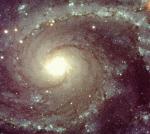 NGC 2997 from VLT
9.03.1999
Add another 8-meter telescope to the list of modern optical telescope giants. Kueyen achieved a first-light photograph of a bright star on March 1, ahead of schedule. The above picture of spiral galaxy...
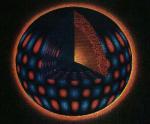 The Sun Oscillates
15.06.1999
Our Sun is in a continual state of oscillation. Large patches of the Sun vibrate in and out, back and forth, even as the Sun rotates. One mode of Solar oscillation is depicted graphically above, with blue indicating outward motion, and red indicating inward motion.
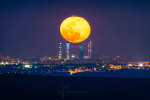 Four Towers and the Equinox Moon
22.03.2019
The first Full Moon of northern spring rises behind four distant towers in this telescopic view. In an image captured from some 40 kilometers west of the city of Madrid, this moonrise also represents a near coincidence of the full lunar phase with lunar perigee and the March equinox.
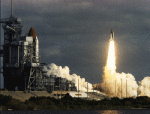 Columbia Waits, Discovery Launches
8.08.1995
Space Shuttle Discovery launches while the Space Shuttle Columbia is readied for a future mission. Space shuttles are launched from the Kennedy Space Center in Florida. At this date there are four operating space shuttles: Atlantis, Columbia, Discovery, and Endeavour. This mission is most famous for carrying the Hubble Space Telescope into orbit.
 Sunset Afterimage
30.05.2025
On May 7, the Sun setting behind a church bell tower was captured in this filtered and manipulated digital skyscape from Ragusa, Sicily, planet Earth. In this version of the image the colors look bizarre.
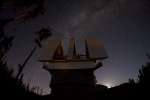 Large Binocular Telescope
15.02.2008
With moonlight on the horizon, a starry sky and the northern Milky Way provide the background for this dramatic view of the World at Night. The imposing structure in the foreground houses the Large Binocular Telescope (LBT), on Mount Graham, Arizona.
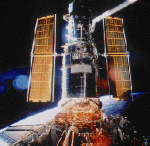 The Orbiting Hubble Space Telescope
10.08.1995
The Hubble Space Telescope (HST) is the largest orbiting public optical telescope in history. Its 2.4 meter diameter reflecting mirror and its perch above Earth's atmosphere allow it to create exceptionally sharp images.
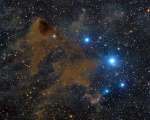 Lynds Dark Nebula 183
20.10.2017
Beverly Lynds Dark Nebula 183 lies a mere 325 light-years away, drifting high above the plane of our Milky Way Galaxy. Obscuring the starlight behind it when viewed at optical wavelengths, the dark, dusty molecular cloud itself seems starless.
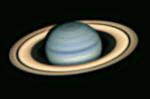 Saturn from Earth
2.09.1998
Saturn is the second largest planet in our Solar System. Saturn has been easily visible in the sky since history has been recorded. Galileo used one of the first telescopes in 1610 to discover Saturn's rings, which he first thought were moons.
|
January February March April May June July August September |
|||||||||||||||||||||||||||||||||||||||||||||||||