
|
You entered: optical
 Recycling Cassiopeia A
6.09.2019
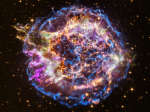
Massive stars in our Milky Way Galaxy live spectacular lives. Collapsing from vast cosmic clouds, their nuclear furnaces ignite and create heavy elements in their cores. After a few million years, the enriched material is blasted back into interstellar space where star formation can begin anew.
 Recycling Cassiopeia A
23.01.2021
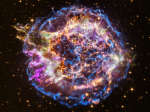
Massive stars in our Milky Way Galaxy live spectacular lives. Collapsing from vast cosmic clouds, their nuclear furnaces ignite and create heavy elements in their cores. After a few million years, the enriched material is blasted back into interstellar space where star formation can begin anew.
 Recycling Cassiopeia A
1.06.2023
Massive stars in our Milky Way Galaxy live spectacular lives. Collapsing from vast cosmic clouds, their nuclear furnaces ignite and create heavy elements in their cores. After a few million years, the enriched material is blasted back into interstellar space where star formation can begin anew.
 APOD: 2026 June 18 Б Possible Supernova Remnant in Galactic Center
18.06.2026
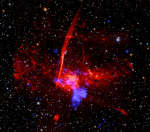
Do you see that blue blob to the lower right of the image center? Astronomers think that it shows where a massive star exploded as a supernova whose light reached Earth 1,700 years ago.
 Lightning on Jupiter
12.05.1997
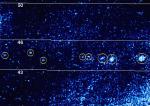
Does lightning occur only on Earth? Spacecraft in our Solar System have detected radio signals consistent with lightning on other planets, including Venus, Jupiter, Saturn, Uranus, and Neptune. In the above photograph, optical flashes from Jupiter were photographed recently by the Galileo orbiter. Each of the circled dots indicates lightning.
 A GRB 000301C Symphony
14.03.2000
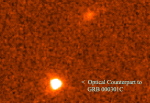
Telescopic instruments in Earth and space are still tracking a tremendous explosion that occurred across the universe. A nearly unprecedented symphony of international observations began abruptly on March 1 when Earth-orbiting RXTE, Sun-orbiting Ulysses, and asteroid-orbiting NEAR all detected a 10-second burst of high-frequency gamma radiation.
 NGC 1365: Barred Spiral Galaxy
8.10.1999
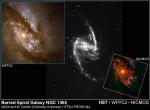
NGC 1365 is a giant barred spiral galaxy about 200,000 light-years in diameter and 60 million light-years distant in the southern constellation Fornax. These three recently released images offer views of this majestic island universe in visible and infrared light.
 Hot Gas and Dark Matter
4.04.1999
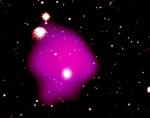
Is the gravity of the galaxies seen in this image high enough to contain the glowing hot gas? Superposed on an optical picture of a group of galaxies is an image taken in X-ray light.
 Hot Gas and Dark Matter
2.09.1995
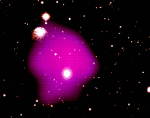
Is the gravity of the above galaxies high enough to contain the glowing hot gas? Superposed on an optical picture of a group of galaxies is an image taken in X-ray light. The X-ray...
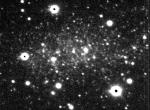 The Aquarius Dwarf
27.07.2003
Our Milky Way Galaxy is not alone. It is part of a gathering of about 50 galaxies known as the Local Group. Members include the Great Andromeda Galaxy (M31), M32, M33, the Large Magellanic Cloud, the Small Magellanic Cloud, Dwingeloo 1, several small irregular galaxies, and many dwarf elliptical and dwarf spheroidal galaxies.
|
January February March April May June July August September |
|||||||||||||||||||||||||||||||||||||||||||||||||