
|
You entered: molecules
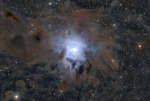 NGC 7023: The Iris Nebula
15.01.2026
These cosmic clouds have blossomed 1,300 light-years away in the fertile starfields of the constellation Cepheus. Called the Iris Nebula, NGC 7023 is not the only nebula to evoke the imagery of flowers.
 APOD: 2023 January 8 Б Where Your Elements Came From
7.01.2023
The hydrogen in your body, present in every molecule of water, came from the Big Bang. There are no other appreciable sources of hydrogen in the universe. The carbon in your body was made by nuclear fusion in the interior of stars, as was the oxygen.
 APOD: 2023 November 27 Б LBN 86: The Eagle Ray Nebula
26.11.2023
This eagle ray glides across a cosmic sea. Officially cataloged as SH2-63 and LBN 86, the dark nebula is composed of gas and dust that just happens to appear shaped like a common ocean fish. The interstellar dust nebula appears light brown as it blocks and reddens visible light emitted behind it.
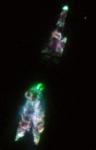 Emerging Planetary Nebula CRL 618
6.09.2000
CRL 618 may look to some like an Olympian declaring victory. Only a few hundred years ago, however, CRL 618 appeared as a relatively modest red giant star. Since then it has run out of core material to fuse and so has started to become a planetary nebula.
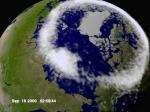 A Proton Aurora
16.12.2003
What are auroras made out of? Most auroras are caused by the solar wind exciting electrons that are funneled down the Earth's magnetic field. These electrons strike air molecules, liberating other electrons that glow when re-acquired.
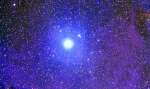 Polaris Dust Nebula
10.01.2008
Centered on North Star Polaris, this 4 degree wide field of view covers part of a complex of relatively unfamiliar, diffuse dust clouds soaring high above the plane of our Milky Way Galaxy.
 Rigel and the Witch Head Nebula
28.12.2009
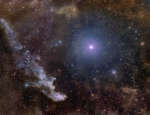
Double, double toil and trouble; Fire burn, and cauldron bubble -- maybe Macbeth should have consulted the Witch Head Nebula. This suggestively shaped reflection nebula on the lower left is associated with the bright star Rigel, to its right, in the constellation Orion.
 APOD: 2023 March 8 Б Artificial Night Sky Brightness
7.03.2023
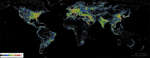
Where have all the dim stars gone? From many places on the Earth including major cities, the night sky has been reduced from a fascinating display of thousands of stars to a diffuse glow through which only a few stars are visible.
 Machholz Meets the Pleiades
10.01.2005
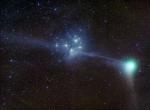
Sweeping northward in planet Earth's sky, comet Machholz extended its long ion tail with the Pleiades star cluster in the background on January 7th. This stunning view, recorded with a telephoto lens in skies over Oberjoch, Bavaria, Germany, emphasizes faint, complex tail structures and the scene's lovely blue and green colors.
 Rigel and the Witch Head Nebula
1.11.2012
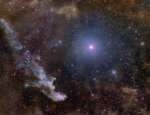
Double, double toil and trouble; Fire burn, and cauldron bubble -- maybe Macbeth should have consulted the Witch Head Nebula. The suggestively shaped reflection nebula is associated with the bright star Rigel in the constellation Orion.
|
January February March April May June July August September |
|||||||||||||||||||||||||||||||||||||||||||||||||