
|
You entered: cluster
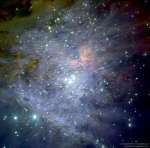 Magnetic Orion
27.02.2019
Can magnetism affect how stars form? Recent analysis of Orion data from the HAWC+ instrument on the airborne SOFIA observatory indicate that, at times, it can. HAWC+ is able to measure the polarization of far-infrared light which can reveal the alignment of dust grains by expansive ambient magnetic fields.
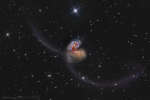 Exploring the Antennae
27.03.2021
Some 60 million light-years away in the southerly constellation Corvus, two large galaxies are colliding. Stars in the two galaxies, cataloged as NGC 4038 and NGC 4039, very rarely collide in the course of the ponderous cataclysm that lasts for hundreds of millions of years.
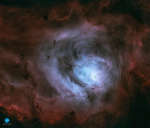 The Lagoon Nebula without Stars
8.08.2022
Ridges of glowing interstellar gas and dark dust clouds inhabit the turbulent, cosmic depths of the Lagoon Nebula. Also known as M8, the bright star forming region is about 5,000 light-years distant.
 Cosmos in Reflection
22.09.2023
During the day, over 12,000 large mirrors reflect sunlight at the 100-megawatt, molten-salt, solar thermal power plant at the western edge of the Gobi desert near Dunhuang, Gansu Province, China. Individual mirror panels turn to track the sun like sunflowers.
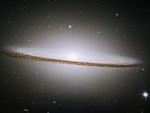 The Sombrero Galaxy from HST
8.10.2003
Why does the Sombrero Galaxy look like a hat? Reasons include the Sombrero's unusually large and extended central bulge of stars, and dark prominent dust lanes that appear in a disk that we see nearly edge-on. Billions of old stars cause the diffuse glow of the extended central bulge.
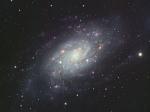 Spiral Galaxy NGC 2403 from Subaru
5.07.2006
Sprawling spiral arms dotted with bright red emission nebulas highlight this new and detailed image of nearby spiral galaxy NGC 2403. Also visible in the photogenic spiral galaxy are blue open clusters, dark dust lanes, and a bright but relatively small central nucleus.
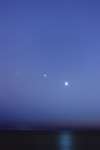 Conjunctions near Dawn
30.06.2012
Now shining in eastern skies at dawn, bright planets Venus and Jupiter join the Pleiades star cluster in this sea and sky scape, recorded earlier this week near Buenos Aires, Argentina. Venus dominates the scene that includes bright star Aldebaran just below and to the right.
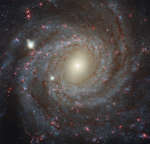 Facing NGC 3344
13.04.2018
From our vantage point in the Milky Way Galaxy, we see NGC 3344 face-on. Nearly 40,000 light-years across, the big, beautiful spiral galaxy is located just 20 million light-years away in the constellation of Leo Minor. This multi-color Hubble Space Telescope close-up of NGC 3344 includes remarkable details from near infrared to ultraviolet wavelengths.
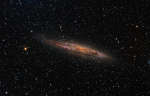 Nearby Spiral Galaxy NGC 4945
22.08.2019
Large spiral galaxy NGC 4945 is seen edge-on near the center of this cosmic galaxy portrait. In fact, it's almost the size of our Milky Way Galaxy. NGC 4945's own dusty disk, young blue star clusters, and pink star forming regions standout in the sharp, colorful telescopic image.
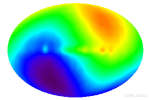 CMB Dipole: Speeding Through the Universe
3.04.2022
Our Earth is not at rest. The Earth moves around the Sun. The Sun orbits the center of the Milky Way Galaxy. The Milky Way Galaxy orbits in the Local Group of Galaxies. The Local Group falls toward the Virgo Cluster of Galaxies.
|
January February March April May June July August September October |
|||||||||||||||||||||||||||||||||||||||||||||||||