
|
You entered: cluster
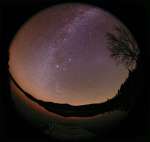 Zodiacal Light and Milky Way
20.10.2012
Ghostly apparitions of two fundamental planes in planet Earth's sky span this October all-sky view. The scene was captured from a lakeside campsite under dark skies in northern Maine, USA. In it, the plane of our Milky Way Galaxy arcs above faint airglow along the horizon.
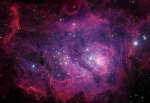 The Wide and Deep Lagoon
9.09.2016
Ridges of glowing interstellar gas and dark dust clouds inhabit the turbulent, cosmic depths of the Lagoon Nebula. Also known as M8, the bright star forming region is about 5,000 light-years distant.
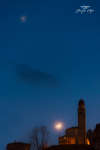 Venus and the Da Vinci Glow
25.03.2023
On March 23 early evening skygazers could watch Venus and a young crescent moon, both near the western horizon. On that date Earth's brilliant evening star, faint lunar night side and slender sunlit crescent were captured in this telephoto skyscape posing alongside a church tower from Danta di Cadore, Dolomiti, Italy.
 APOD: 2023 December 13 Б Deep Field: The Heart Nebula
13.12.2023
What excites the Heart Nebula? First, the large emission nebula on the left, catalogued as IC 1805, looks somewhat like a human heart. The nebula glows brightly in red light emitted by its most prominent element, hydrogen, but this long-exposure image was also blended with light emitted by silicon (yellow) and oxygen (blue).
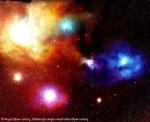 Antares and Rho Ophiuchi
21.05.2000
Why is the sky near Antares and Rho Ophiuchi so colorful? The colors result from a mixture of objects and processes. Fine dust illuminated from the front by starlight produces blue reflection nebulae. Gaseous clouds whose atoms are excited by ultraviolet starlight produce reddish emission nebulae. Backlit dust clouds block starlight and so appear dark.
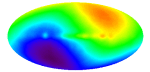 COBE Dipole: Speeding Through the Universe
5.02.1996
Our Earth is not at rest. The Earth moves around the Sun. The Sun orbits the center of the Milky Way Galaxy. The Milky Way Galaxy orbits in the Local Group. The Local Group falls toward the Virgo Cluster of Galaxies.
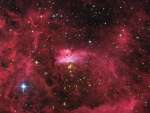 Massive Stars in NGC 6357
9.10.2008
Massive Stars lie within NGC 6357, an expansive emission nebula complex some 8,000 light-years away in the tail of the constellation Scorpius. In fact, positioned just below center in this close-up view...
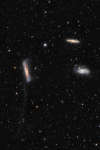 The Tidal Tail of NGC 3628
6.07.2012
A mere 30 million light-years away, large spiral galaxy NGC 3628 (center left) shares its neighborhood in the local Universe with two other large spirals, in a magnificent grouping otherwise known as the Leo Triplet.
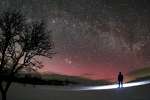 Comet of the North
5.04.2013
It looks like a double comet, but Comet PanSTARRS (C/2011 L4) is just offering skygazers a Messier moment. Outward bound and fading in this starry scene, the well-photographed comet is remarkably similar in brightness to M31, the Andromeda Galaxy.
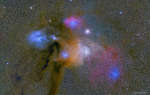 Colorful Clouds Near Rho Ophiuchi
6.07.2015
Why is the sky near Antares and Rho Ophiuchi so colorful? The colors result from a mixture of objects and processes. Fine dust illuminated from the front by starlight produces blue reflection nebulae. Gaseous clouds whose atoms are excited by ultraviolet starlight produce reddish emission nebulae. Backlit dust clouds block starlight and so appear dark.
|
January February March April May June July August September October |
|||||||||||||||||||||||||||||||||||||||||||||||||