
|
You entered: stars
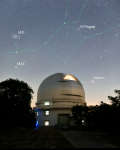 APOD: 2025 October 10 Б 50 Light-years to 51 Pegasi
10.10.2025
It's only 50 light-years to 51 Pegasi. That star's position is indicated in this snapshot from August 2025, taken on a night with mostly brighter stars visible above the dome at Observatoire de Haute-Provence in France.
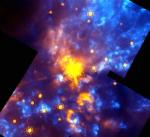 The Heart Of Orion
6.05.2000
Newborn stars lie at at the heart of the the Orion Nebula, hidden from view by the dust and gas of the giant Orion Molecular Cloud number 1 (OMC-1). Sensitive to invisible infrared...
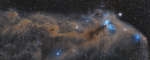 Across Corona Australis
29.11.2018
Cosmic dust clouds are draped across a rich field of stars in this broad telescopic panorama near the northern boundary of Corona Australis, the Southern Crown. Less than 500 light-years away the denser clouds effectively block light from more distant background stars in the Milky Way.
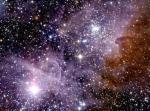 The Keyhole Nebula in Infrared
13.06.2000
About three million years ago, the stars in the Keyhole Nebula began to form. The above picture of the Keyhole Nebula, also known as the Carina Nebula or NGC 3372, shows in infrared light many facets of this dramatic stellar nursery which lies only 9,000 light-years away.
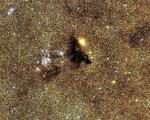 Open Cluster NGC 6520 from CFHT
22.07.2002
Did you ever have a day when it felt like a dark cloud was following you around? For the open cluster of stars NGC 6520, every day is like this. On the left of the above picture are many of NGC 6520's bright blue stars.
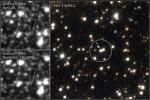 A Big Black Hole Floats By
19.01.2000
A black hole glides silently through space. Is there any way to know it's there? Until last week, all objects that might be black holes in our Galaxy were part of binary star systems.
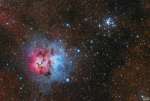 Messier 20 and 21
28.08.2014
The beautiful Trifid Nebula, also known as Messier 20, is easy to find with a small telescope in the nebula rich constellation Sagittarius. About 5,000 light-years away, the colorful study in cosmic contrasts shares this well-composed, nearly 1 degree wide field with open star cluster Messier 21 (top right).
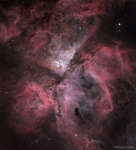 The Great Nebula in Carina
23.03.2016
In one of the brightest parts of Milky Way lies a nebula where some of the oddest things occur. NGC 3372, known as the Great Nebula in Carina, is home to massive stars and changing nebulas.
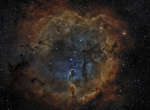 IC 1396: Emission Nebula in Cepheus
20.07.2017
Stunning emission nebula IC 1396 mixes glowing cosmic gas and dark dust clouds in the high and far off constellation of Cepheus. Energized by the bright central star seen here, this star forming region sprawls across hundreds of light-years, spanning over three degrees on the sky while nearly 3,000 light-years from planet Earth.
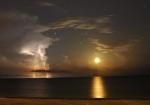 Moon Lightning
7.10.2004
Moonsets are not often quite as exciting as this one. But amateur astronomer Marc-Andre Besel was impressed by the brilliant lighting displays that joined the first quarter Moon and stars of the constellation Scorpius in western skies.
|
January February March April May June July August September October |
|||||||||||||||||||||||||||||||||||||||||||||||||