
|
You entered: stars
 When Vega is North
8.05.2015
In only about 12,000 years Vega will be the North Star, the closest bright star to our fair planet's North Celestial Pole. By then, when you fix your camera to a tripod...
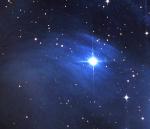 Reflection Nebula NGC 1435
1.03.1999
Reflection nebulae reflect light from a nearby star. Many small carbon grains in the nebula reflect the light. The blue color typical of reflection nebula is caused by blue light being more efficiently scattered by the carbon dust than red light.
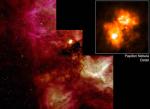 N159 and the Papillon Nebula
14.06.1999
In a search for massive stars, the Hubble Space Telescope has peered into yet another spectacular region of star formation. This nebula, known as N159, spans over 150 light-years and is located in the neighboring Large Magellanic Cloud galaxy, about 170,000 light years distant.
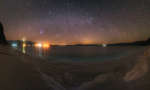 Sky Panorama Over Lake Salda
22.04.2009
As midnight approached, a spectacular sky appeared. Such was the case last month from the shore of Lake Salda in southwestern Turkey. In the above night sky panorama, rocky sand covers the foreground, while building lights are visible across the lake.
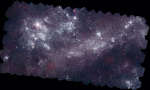 The Large Magellanic Cloud in Ultraviolet
10.06.2013
Where are the hottest stars in the nearest galaxies? To help find out, NASA commissioned its Earth-orbiting Swift satellite to compile a multi-image mosaic of the neighboring Large Magellanic Cloud (LMC) galaxy in ultraviolet light.
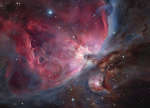 At the Heart of Orion
1.01.2015
Near the center of this sharp cosmic portrait, at the heart of the Orion Nebula, are four hot, massive stars known as the Trapezium. Tightly gathered within a region about 1.5 light-years in radius, they dominate the core of the dense Orion Nebula Star Cluster.
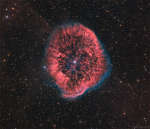 APOD: 2023 February 8 Б Stellar Wind Shaped Nebula RCW 58
8.02.2023
Imagine traveling to a star about 100 times as massive as our Sun, a million times more luminous, and with 30 times the surface temperature. Such stars exist, and some are known as Wolf Rayet (WR) stars, named after French astronomers Charles Wolf and Georges Rayet.
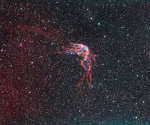 RCW 86: Historical Supernova Remnant
28.05.2022
In 185 AD, Chinese astronomers recorded the appearance of a new star in the Nanmen asterism. That part of the sky is identified with Alpha and Beta Centauri on modern star charts. The new star was visible for months and is thought to be the earliest recorded supernova.
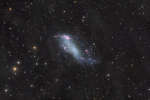 IC 2574: Coddington s Nebula
19.02.2026
Grand spiral galaxies often seem to get all the glory, flaunting their young, bright, blue star clusters in beautiful, symmetric spiral arms. But small, irregular galaxies form stars too. In fact, dwarf galaxy IC 2574 shows clear evidence of intense star forming activity in its telltale reddish regions of glowing hydrogen gas.
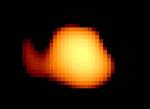 Resolving Mira
11.10.1998
Most stars appear only as points of light. Early last year, Betelgeuse became the second star, after our Sun, to have it surface resolved. Later last year, Mira was added to the list. Mira...
|
January February March April May June July August September October |
|||||||||||||||||||||||||||||||||||||||||||||||||