
|
You entered: Earth
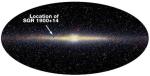 Magnetar In The Sky
2.10.1998
Indicated on this infrared image of the galactic center region is the position of SGR 1900+14 - the strongest known magnet in the galaxy. SGR 1900+14 is believed to be a city-sized, spinning, super-magnetic neutron star, or Magnetar. How strong is a Magnetar's magnetic field?
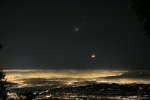 A Happy Sky over Los Angeles
12.11.2017
Sometimes, the sky may seem to smile over much of planet Earth. On this day in 2008, visible the world over, was an unusual superposition of our Moon and the planets Venus and Jupiter.
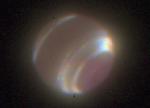 Neptune through Adaptive Optics
18.02.2000
From the Earth's surface, Neptune usually appears as a fuzzy blotch. The blurring effects of the Earth's atmosphere deny clearer images. By distorting mirrors in the telescope itself in time with the changing atmosphere, however, these effects can be greatly reduced.
 A RADARSAT Map of Antarctica
16.11.1999
It's not easy to make a map of Antarctica. Earth's southern most continent is so cold and inhospitable that much of it remains unexplored. From space, though, it is possible to map this entire region by radar: by systematically noting how long it takes for radio waves to reflect off the terrain.
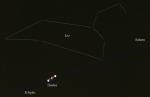 Eclipse and Ecliptic
9.03.2007
When a Full Moon lies near the ecliptic there can be a lunar eclipse. That cosmic alignment is well illustrated in this composite of eclipse images recorded last Saturday near Paris, France. The projection...
 Venus Just After Sunset
20.10.2010
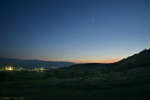
Is that Venus or an airplane? A common ponderable for sky enthusiasts is deciding if that bright spot near the horizon is the planet Venus. Usually, an airplane will show itself by moving significantly in a few moments. Venus will set only slowly as the Earth turns.
 Aurora Over Iceland
21.03.2012
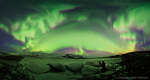
If you see a sky like this -- photograph it. Three nights ago in Iceland, an adventurous photographer (pictured) chanced across a sky full of aurora and did just that. Afterwards, by stitching together five smaller photographs, the entire aurora-lit sky was recreated in this 180-degree panorama taken from VatnajЖkull glacier.
 Solstice Dawn and Full Moonset
23.06.2016
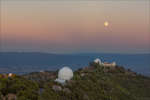
A Full Moon sets as the Solstice Sun rises in this June 20 dawn skyscape. Captured from a nearby peak in central California, planet Earth, the scene looks across the summit of Mount Hamilton and Lick Observatory domes on a calendar date that marks an astronomical change of seasons and hemispherical extremes of daylight hours.
 Five Planets and the Moon over Australia
16.08.2016
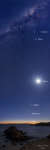
It is not a coincidence that planets line up. That's because all of the planets orbit the Sun in (nearly) a single sheet called the plane of the ecliptic. When viewed from inside that plane -- as Earth dwellers are likely to do -- the planets all appear confined to a single band.
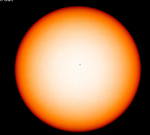 Mercury Crosses a Quiet Sun
2.12.2019
What's that black dot crossing the Sun? The planet Mercury. Mercury usually passes over or under the Sun, as seen from Earth, but last month the Solar System's innermost planet appeared to go just about straight across the middle.
|
January February March April May June July August September October |
|||||||||||||||||||||||||||||||||||||||||||||||||