
|
You entered: Earth
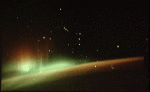 Aurora and Orion
14.11.1995
Looking toward the south from low Earth orbit, the crew of the Space Shuttle Endeavor made this stunning time exposure of the Aurora Australis (southern lights) in April of 1994. The aurora are caused by high energy electrons from the Solar Wind which are funneled into the atmosphere by the Earth's magnetic field.
 Gemini South Star Trails
1.09.2006
Stars seem to arc through southern skies in this surrealistic time exposure -- recorded before moonrise from the Gemini South Observatory, Cerro Pachon, Chile, Planet Earth. During the one hour 40 minute exposure camera and tripod were fixed, so the concentric star trails are a reflection of Earth's daily rotation about its axis.
 La Palma Eclipse Sequence
7.10.2015
At left, a dramatic image sequence follows late September's total lunar eclipse above a rugged landscape and sea of clouds from the Canary island of La Palma. Composited in a circular fisheye projection...
 APOD: 2025 August 23 Б Fishing for the Moon
23.08.2025
How big is planet Earth's Moon? Compared to other moons of the Solar System, it's number 5 on the largest to smallest ranked list, following Jupiter's moon Ganymede, Saturn's moon Titan, and Jovian moons Callisto and Io. Continuing the list, the Moon comes before Jupiter's Europa and Neptune's Triton.
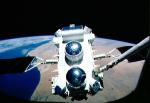 The Compton Gamma Ray Observatory
16.01.2000
The Compton Gamma Ray Observatory (CGRO) was the most massive instrument ever launched by a NASA Space Shuttle in 1991 and continues to revolutionize gamma-ray astronomy. Before Compton loses more stabilizing gyroscopes, NASA is considering firing onboard rockets to bring it on a controlled reentry into the ocean.
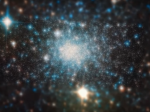 Zooming in on Star Cluster Terzan 5
24.03.2019
Globular clusters once ruled the Milky Way. Back in the old days, back when our Galaxy first formed, perhaps thousands of globular clusters roamed our Galaxy. Today, there are less than 200 left. Over the eons, many globular clusters were destroyed by repeated fateful encounters with each other or the Galactic center.
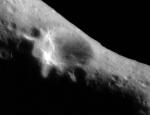 Eros From Orbit
16.02.2000
On February 14th, the NEAR spacecraft became the first artificial moon of an asteroid. Captured by the gentle gravity of a 20 mile long slipper-shaped mountain of rock, NEAR recorded this premier image while orbiting asteroid 433 Eros at a distance of about 200 miles.
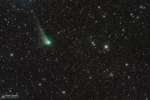 Two Comets in Southern Skies
8.10.2022
Heading for its closest approach to the Sun or perihelion on December 20, comet C/2017 K2 (PanSTARRS) remains a sight for telescopic observers as it sweeps through planet Earth's southern hemisphere skies. First...
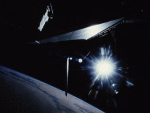 The Equal Night
22.09.1996
Today the Sun crosses the celestial equator heading south -- marking the Autumnal Equinox, the first day of Autumn. Equinox means equal night and with the Sun on the celestial equator, Earthlings will experience 12 hours of daylight and 12 hours of darkness.
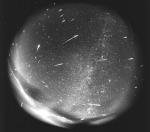 Leonids from Leo
8.12.1998
Is Leo leaking? Leo, the famous sky constellation visible on the left of the above all-sky photograph, appears to be the source of all the meteors seen in this year's Leonids Meteor Shower.
|
January February March April May June July August September October |
|||||||||||||||||||||||||||||||||||||||||||||||||