
|
You entered: hydrogen
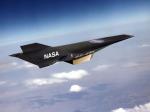 NASAs X 43A Scramjet Sets Air Speed Record
29.03.2004
Using oxygen from the air itself, a NASA experimental jet propelled itself past Mach 7 in the atmosphere above the Pacific Ocean this weekend. The small automated X-43A Hyper-X craft was dropped from a huge converted B-52 bomber and then accelerated by a standard Pegasus rocket.
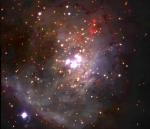 Free Floating Planets In Orion
31.03.2000
This false-colour image of the young Trapezium star cluster in the Orion Nebula was made with an infrared camera at wavelengths about twice as long as visible light. The infrared data are part...
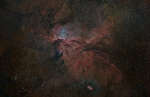 NGC 6188 and NGC 6164
1.02.2014
Fantastic shapes lurk in clouds of glowing gas in NGC 6188, about 4,000 light-years away. The emission nebula is found near the edge of a large molecular cloud unseen at visible wavelengths, in the southern constellation Ara.
 M51: Tidal Streams and H-alpha Ciffs
13.12.2024
An intriguing pair of interacting galaxies, M51 is the 51st entry in Charles Messier's famous catalog. Perhaps the original spiral nebula, the large galaxy with whirlpool-like spiral structure seen nearly face-on is also cataloged as NGC 5194. Its spiral arms and dust lanes sweep in front of its smaller companion galaxy, NGC 5195.
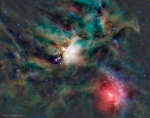 Young Stars in the Rho Ophiuchi Cloud
17.11.2019
How do stars form? To help find out, astronomers created this tantalizing false-color composition of dust clouds and embedded newborn stars in infrared wavelengths with WISE, the Wide-field Infrared Survey Explorer. The cosmic canvas...
 The Dark River to Antares
16.05.2020
A dark river seems to flow through this sky from the horizon toward colorful clouds near red giant star Antares. Murky looking, the dark river is a dusty nebula obscuring background starlight near the central Milky Way, although the dark dust nebula contains mostly hydrogen molecular gas.
 Simulation: A Disk Galaxy Forms
17.07.2012
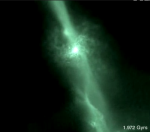
How do galaxies like our Milky Way form? Since our universe moves too slowly to watch, faster-moving computer simulations are created to help find out. Green depicts (mostly) hydrogen gas in the above movie, while time is shown in billions of years since the Big Bang on the lower right.
 Illustris Simulation of the Universe
23.02.2020
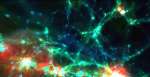
How did we get here? Click play, sit back, and watch. A computer simulation of the evolution of the universe provides insight into how galaxies formed and perspectives into humanity's place in the universe.
 APOD: 2023 December 31 Б Illustris: A Simulation of the Universe
31.12.2023
How did we get here? Click play, sit back, and watch. A computer simulation of the evolution of the universe provides insight into how galaxies formed and perspectives into humanity's place in the universe.
 Downtown Auriga
13.02.2014
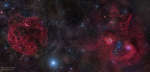
Rich in star clusters and nebulae, the ancient constellation of Auriga, the Charioteer, rides high in northern winter night skies. Spanning nearly 24 full moons (12 degrees) on the sky, this deep telescopic mosaic view recorded in January shows off some of Auriga's most popular sights for cosmic tourists.
|
January February March |
||||||||||||||||||||||||||||||||||||||||||||||||||||||||