
|
You entered: hydrogen
 NGC 6164: A Dragon s Egg
24.04.2025
Beautiful emission nebula NGC 6164 was created by a rare, hot, luminous O-type star, some 40 times as massive as the Sun. Seen at the center of the cosmic cloud, the star is a mere 3 to 4 million years old.
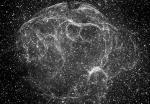 Simeis 147: Supernova Remnant
30.08.2002
It's easy to get lost following the intricate filaments in this stunningly detailed image of faint supernova remnant Simeis 147. Seen towards the constellation Taurus it covers nearly 3 degrees (6 full moons)...
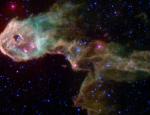 Inside The Elephant s Trunk
19.12.2003
Spectacular first images from the newly christened Spitzer Space Telescope include this penetrating interior view of an otherwise opaque dark globule known as the Elephant's Trunk Nebula. Seen in a composite of infrared...
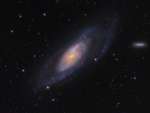 Messier 106
29.05.2009
Close to the Great Bear (Ursa Major) and surrounded by the stars of the Hunting Dogs (Canes Venatici), this celestial wonder was discovered in 1781 by the metric French astronomer Pierre Mechain. Later, it was added to the catalog of his friend and colleague Charles Messier as M106.
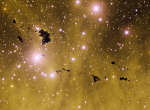 Thackerays Globules
12.06.2012
These are larger dust bunnies than you will find under your bed. Situated in rich star fields and glowing hydrogen gas, these opaque clouds of interstellar dust and gas are so large they might be able to form stars.
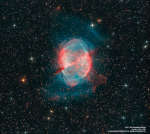 M27: Not a Comet
20.08.2015
While hunting for comets in the skies above 18th century France, astronomer Charles Messier diligently kept a list of the things he encountered that were definitely not comets. This is number 27 on his now famous not-a-comet list.
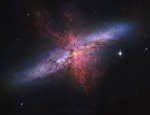 M82: Galaxy with a Supergalactic Wind
23.07.2019
Why is the Cigar Galaxy billowing red smoke? M82, as this starburst galaxy is also known, was stirred up by a recent pass near large spiral galaxy M81. This doesn't fully explain the source of the red-glowing outwardly expanding gas and dust, however.
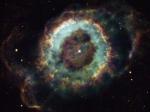 NGC 6369: The Little Ghost Nebula
7.02.2004
This pretty planetary nebula, cataloged as NGC 6369, was discovered by 18th century astronomer William Herschel as he used a telescope to explore the medicinal constellation Ophiucus. Round and planet-shaped, the nebula is also relatively faint and has acquired the popular moniker of Little Ghost Nebula.
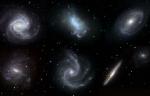 Visitors Galaxy Gallery
18.06.2005
A tantalizing assortment of island universes is assembled here. From top left to bottom right are the lovely but distant galaxies M61, NGC 4449, NGC 4725, NGC 5068, NGC 5247, and NGC 5775/5774. Most are spiral galaxies more or less like our own Milky Way.
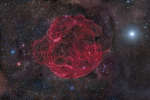 Simeis 147: Supernova Remnant
9.10.2012
It's easy to get lost following the intricate filaments in this detailed mosaic image of faint supernova remnant Simeis 147 (S147). Also cataloged as Sh2-240, it covers nearly 3 degrees or 6 full moons on the sky. That's about 150 light-years at the stellar debris cloud's estimated distance of 3,000 light-years.
|
January February March April May June July August September |
|||||||||||||||||||||||||||||||||||||||||||||||||