
|
You entered: map
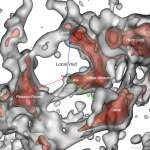 The Local Void in the Nearby Universe
5.08.2019
What does our region of the Universe look like? Since galaxies are so spread out over the sky, and since our Milky Way Galaxy blocks part of the distant sky, it has been hard to tell.
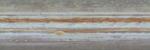 Jupiter Unpeeled
6.09.2003
Slice Jupiter from pole to pole, peel back its outer layers of clouds, stretch them onto a flat surface ... and for all your trouble you'd end up with something that looks a lot like this. Scrolling right will reveal the full picture, a color mosaic of Jupiter from the Cassini spacecraft.
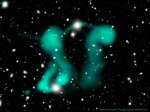 Dancing Ghosts: Curved Jets from Active Galaxies
31.08.2021
Why would galaxies emit jets that look like ghosts? And furthermore, why do they appear to be dancing? The curled and fluffy jets from the supermassive black holes at the centers of two host galaxies (top center and lower left) are unlike anything seen before.
 Lunar Prospects
18.09.1998
Launched on January 6th, NASA's Lunar Prospector spacecraft has been exploring the Moon with instruments designed to sense global properties while orbiting pole-to-pole, 63 miles above the lunar surface. Now over half...
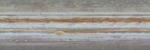 Jupiter Unpeeled
14.02.2001
Slice Jupiter from pole to pole, peel back its outer layers of clouds, stretch them onto a flat surface ... and for all your trouble you'd end up with something that looks a lot like this. Scrolling right will reveal the full picture, a color mosaic of Jupiter from the Cassini spacecraft.
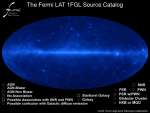 Fermi Catalogs the Gamma ray Sky
17.03.2010
What shines in the gamma-ray sky? The most complete answer yet to that question is offered by the Fermi Gamma-ray Space Telescope's first all-sky catalog. Fermi's sources of cosmic gamma-rays feature nature...
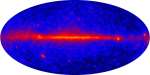 Fermi's First Light
28.08.2008
Launched on June 11 to explore the universe at extreme energies, the Gamma-ray Large Area Space Telescope has been officially renamed the Fermi Gamma-ray Space Telescope, in honor of Nobel Laureate Enrico Fermi (1901-1954), pioneer in high-energy physics.
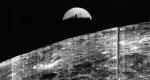 The Earth Also Rises
24.03.2000
The Lunar Orbiter 1 spacecraft was launched in 1966 to map the lunar surface in preparation for the Apollo moon landings. NASA's plucky robotic explorer performed its job well and pioneered this classic view of the Earth poised above the lunar horizon.
 Where People Live on Planet Earth
4.03.2003
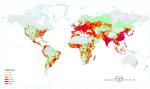
Where do people live on Planet Earth? Although people inhabit every continent, the highest population densities occur in Asia. Sparsely inhabited regions occur on virtually every continent, however, including the Sahara Desert in Africa...
 Fields of Minerals on Ganymede
6.11.1996
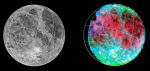
What treasures lie on the surface of Ganymede? Last week, NASA released a map of Jupiter's largest moon made by the Galileo Orbiter highlighting ice and minerals deposits. The leftmost photograph by Voyager...
|
January February March April May June July August September |
|||||||||||||||||||||||||||||||||||||||||||||||||