
|
You entered: map
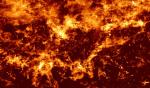 Billows of Smog in the Outer Galaxy
14.01.2001
Our Galaxy is filled with gas. Most of this gas is hydrogen, some is helium, but there is a trace amount of relatively heavy molecules, including carbon monoxide (CO) - a component of smog. The above wide-angle radio CO image shows the incredibly diverse structures that the molecular interstellar medium forms.
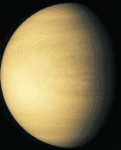 Venus: Earth's Sister Planet
15.08.1995
This picture in visible light was taken by the Galileo spacecraft. Venus is very similar to Earth in size and mass - and so is sometimes referred to as Earth's sister planet - but Venus has a quite different climate.
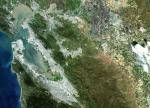 Landsat 7 Views Planet Earth
14.05.1999
Launched last month, NASA's Landsat 7 spacecraft now orbits planet Earth. Looking down from an altitude of 700 km, Landsat 7 can map the planet's surface in visible and infrared bands and resolve features 30 meters across or smaller.
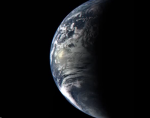 Leaving Earth
5.08.2013
What it would look like to leave planet Earth? Such an event was recorded visually in great detail by the MESSENGER spacecraft as it swung back past the Earth, eight years ago, on its way in toward the planet Mercury. Earth can be seen rotating in this time-lapse video, as it recedes into the distance.
 The Nearest Stars
17.03.2001
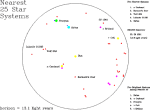
Which stars are closest to the Sun? The closest is Proxima Centauri, one of three stars that orbit each other about 4 light-years away in the Alpha-Centauri system. Alpha Centauri is easily visible from Earth's
 Venus Once Molten Surface
16.09.2001
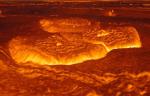
If you could look at Venus with radar eyes - this is what you might see. This computer reconstruction of the surface of Venus was created from data from the Magellan spacecraft. Magellan orbited Venus and used radar to map our neighboring planet's surface between 1990 and 1994.
 The Nearest Stars
21.04.1999
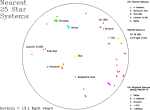
Which stars are closest to the Sun? The closest is Proxima Centauri, one of three stars that orbit each other about 4 light-years away in the Alpha-Centauri system. Alpha Centauri is easily visible from Earth's Southern Hemisphere. Next is Barnard's Star, a dim star visible with a telescope in the constellation of Ophiuchus.
 Lunar Dust and Duct Tape
27.03.2025
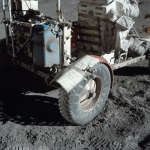
Why is the Moon so dusty? On Earth, rocks are weathered by wind and water, creating soil and sand. On the Moon, eons of constant micrometeorite bombardment have blasted away at the rocky surface creating a layer of powdery lunar soil or regolith.
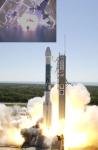 Mars Odyssey Lifts Off for Mars
9.04.2001
Next stop: Mars. On Saturday the 2001 Mars Odyssey spacecraft lifted off from Cape Canaveral, Florida on a path to enter orbit around Mars in late October. Pictured above, a Delta II rocket lifted...
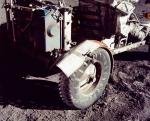 Lunar Dust and Duct Tape
9.11.2001
Why is the Moon dusty? On Earth, rocks are weathered by wind and water, creating soil and sand. On the Moon, the long history of micrometeorite bombardment has blasted away at the rocky surface creating a layer of powdery lunar soil or regolith. This lunar regolith could be a scientific and industrial bonanza.
|
January February March April May June July August |
||||||||||||||||||||||||||||||||||||||||||||||||||||||||