
|
You entered: apod
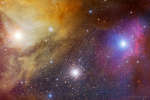 Antares and Clouds
17.04.2012
Antares is a huge star. In a class called red supergiant, Antares is about 850 times the diameter of our own Sun, 15 times more massive, and 10,000 times brighter. Antares is the brightest star in the constellation of Scorpius and one of the brighter stars in all the night sky.
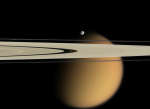 Titan Beyond the Rings
1.11.2014
When orbiting Saturn, be sure to watch for breathtaking superpositions of moons and rings. One such picturesque vista was visible recently to the robot Cassini spacecraft now orbiting Saturn. In 2006 April, Cassini captured Saturn's A and F rings stretching in front of cloud-shrouded Titan.
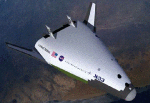 NASA's Latest Rockets: X-33
2.07.1996
What will NASA rockets look like in the future? Today's announcement gave one indication. Today Vice- President Al Gore announced that the Lockheed Martin Corporation will work with NASA to produce a reusable rocket with a remote pilot.
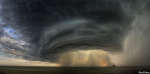 A Supercell Thunderstorm Cloud Over Montana
5.05.2013
Is that a spaceship or a cloud? Although it may seem like an alien mothership, it's actually a impressive thunderstorm cloud called a supercell. Such colossal storm systems center on mesocyclones -- rotating updrafts that can span several kilometers and deliver torrential rain and high winds including tornadoes.
 Total Totality
12.04.2024
Baily's beads often appear at the boundaries of the total phase of an eclipse of the Sun. Pearls of sunlight still beaming through gaps in the rugged terrain along the lunar limb silhouette, their appearance is recorded in this dramatic timelapse composite.
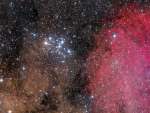 M6: The Butterfly Cluster
3.09.2014
To some, the outline of the open cluster of stars M6 resembles a butterfly. M6, also known as NGC 6405, spans about 20 light-years and lies about 2,000 light years distant. M6, pictured...
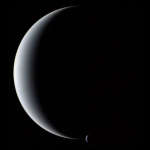 Crescent Neptune and Triton
13.12.2009
Gliding silently through the outer Solar System, the Voyager 2 spacecraft camera captured Neptune and Triton together in crescent phase in 1989. The above picture of the gas giant planet and its cloudy moon was taken from behind just after closest approach.
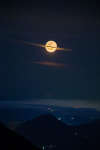 A Moon Dressed Like Saturn
2.08.2022
Why does Saturn appear so big? It doesn't -- what is pictured are foreground clouds on Earth crossing in front of the Moon. The Moon shows a slight crescent phase with most of its surface visible by reflected Earthlight known as ashen glow.
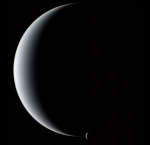 Crescent Neptune and Triton
14.04.2013
Gliding silently through the outer Solar System, the Voyager 2 spacecraft camera captured Neptune and Triton together in crescent phase in 1989. The elegant picture of the gas giant planet and its cloudy moon was taken from behind just after closest approach.
 Zooming in to the Pelican Nebula
2.07.2007
Where on the sky is the Pelican Nebula? APOD features many objects on the night sky, but usually does not have the resources to show exactly where on the night sky each objects lies.
|
January February March April May June July August September |
|||||||||||||||||||||||||||||||||||||||||||||||||