
|
You entered: dark
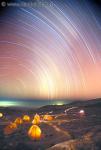 The Star Trails of Kilimanjaro
11.09.2004
The night had no moon, but the stars were out. And camped at 16,000 feet on Mt. Kilimanjaro, photographer Dan Heller recorded this marvelous 3 1/2 hour long exposure. Here the landscape is lit mostly by the stars.
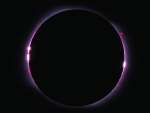 At the Sun s Edge
7.08.2008
A train trip on the Trans-Siberian railway to Novosibirsk resulted in this stunning view along the edge of the Sun recorded during the August 1st total solar eclipse. The picture is a composite...
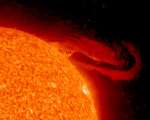 A Solar Prominence Unfurls
4.10.2008
On September 29, this magnificent eruptive solar prominence lifted away from the Sun's surface, unfurling into space over the course of several hours. Suspended in twisted magnetic fields, the hot plasma structure is many times the size of planet Earth and was captured in this view by the Sun-watching STEREO (Ahead) spacecraft.
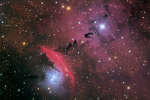 Stars, Dust and Nebula in NGC 6559
2.08.2009
When stars form, pandemonium reigns. A textbook case is the star forming region NGC 6559. Visible above are red glowing emission nebulas of hydrogen, blue reflection nebulas of dust, dark absorption nebulas of dust, and the stars that formed from them.
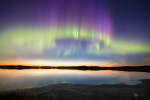 Northern Lights and Noctilucent Clouds
21.06.2018
Skies after the near-solstice sunset on June 17 are reflected in this calm lake. The tranquil twilight scene was captured near Bashaw, Alberta, Canada, northern planet Earth. Usually spotted at high latitudes in summer months, night shining or noctilucent clouds hang just above the horizon, transfusing light into a darker sky.
 APOD: 2023 June 5 Б In the Center of the Trifid Nebula
5.06.2023
What's happening at the center of the Trifid Nebula? Three prominent dust lanes that give the Trifid its name all come together. Mountains of opaque dust appear near the bottom, while other dark filaments of dust are visible threaded throughout the nebula.
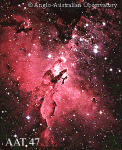 M16: Dust and an Open Cluster
1.11.1995
The photogenic M16 shown above is composed of a young star cluster and a spectacular emission nebulae lined with distinct regions of interstellar dust. Most of the stars in the cluster can be seen offset just above and to the right of the photograph's center.
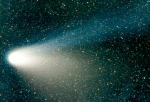 Comet Hale-Bopp Enters the Evening Sky
7.03.1997
You no longer have to wake-up early to see Comet Hale-Bopp. From many northern locations, you can now go outside just after sunset and see Comet Hale-Bopp above the north-western horizon. Both writer/editors of APOD are impressed by how bright Comet Hale-Bopp has become, and how easily visible it is.
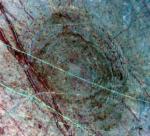 Impact on Europa
15.08.1997
This bull's-eye pattern marks the impact of a mountain-sized comet or asteroid on the icy surface of Jupiter's moon Europa. Recorded by the Galileo spacecraft in April of this year, the composite false color image clearly reveals the telltale concentric fractures which cover about
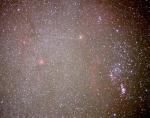 Meteor Milky Way
26.11.1998
The bold, bright star patterns of Orion (right) are a familiar sight to even casual skygazers. But this gorgeous color photo also features a subtler spectacle - the faint stars of the Milky Way.
|
January February March April May June July August September |
|||||||||||||||||||||||||||||||||||||||||||||||||