
|
You entered: dark
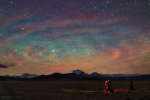 Airglow Ripples over Tibet
20.11.2022
Why would the sky look like a giant target? Airglow. Following a giant thunderstorm over Bangladesh in late April, giant circular ripples of glowing air appeared over Tibet, China, as pictured here. The unusual...
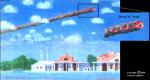 A Daytime Fireball in 1944
16.11.2000
While stationed in central Africa in December 1944, Norman Appleton witnessed a meteor so bright he remembered it his entire life. Right before his eyes a tremendous smoking fireball streaked across the daytime sky. Years later, as an accomplished member of the Guild of Aviation Artists, he recorded his memories in the above painting.
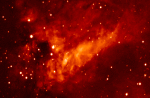 M17: The Majestic Swan Nebula
29.08.1996
What unusual eggs have been laid by this majestic swan? The star forming region above, known as Swan Nebula, is the home of hot red-glowing gas, dark lanes of dust, bright young stars and -- what are those?
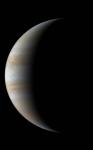 Farewell Jupiter
9.03.2003
Next stop: Saturn. The Cassini spacecraft, launched from Earth in 1997, has now swung past Jupiter and should arrive at Saturn in the year 2004. Pictured to the left is a parting shot from Cassini in January that would not have been possible from Earth: Jupiter showing a crescent phase.
 NGC 253: The Sculptor Galaxy
16.03.2003
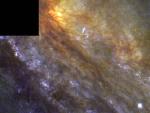
NGC 253 is not only one of the brightest spiral galaxies visible, it is also one of the dustiest. Discovered in 1783 by Caroline Herschel in the constellation of Sculptor, NGC 253 lies only about ten million light-years distant.
 Crescent Neptune and Triton
18.06.2006
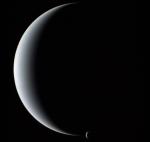
Gliding silently through the outer Solar System, the Voyager 2 spacecraft camera captured Neptune and Triton together in crescent phase in 1989. The above picture of the gas giant planet and its cloudy moon was taken from behind just after closest approach.
 Three Galaxies and a Comet
20.10.2013
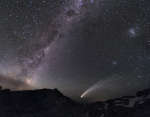
Diffuse starlight and dark nebulae along the southern Milky Way arc over the horizon and sprawl diagonally through this gorgeous nightscape. The breath-taking mosaic spans a wide 100 degrees, with the rugged terrain of the Patagonia, Argentina region in the foreground.
 Moon Venus Mars Skyline
27.02.2015
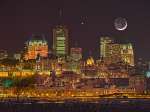
Taken on February 20, five different exposures made in rapid succession were used to created this tantalizing telephoto image. In combination, they reveal a wide range of brightness visible to the eye on that frigid evening, from the urban glow of the Quebec City skyline to the triple conjunction of Moon, Venus and Mars.
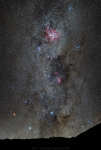 The Southern Cross in a Southern Sky
19.10.2015
Have you ever seen the Southern Cross? This famous constellation is best seen from Earth's Southern Hemisphere. Captured from Rio de Janeiro, Brazil, the four bright stars that mark the Southern Cross are visible just above the horizon in the featured image.
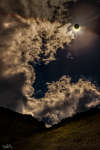 Reunion Island Eclipse
3.09.2016
The New Moon's dark shadow crossed planet Earth on September 1. In silhouette the Moon didn't quite cover the Sun though, creating an an annular solar eclipse. The shadow's narrow central path was about 100 kilometers wide at maximum eclipse.
|
January February March April May June July August September |
|||||||||||||||||||||||||||||||||||||||||||||||||