
|
You entered: clouds
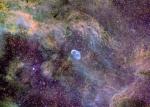 NGC 6888: A Tricolor Starfield
6.07.2006
NGC 6888, also known as the Crescent Nebula, is a cosmic bubble about 25 light-years across, blown by winds from its central, bright, massive star. Near the center of this intriguing widefield view of interstellar gas clouds and rich star fields of the constellation Cygnus, NGC 6888 is about 5,000 light-years away.
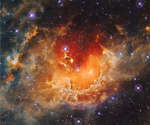 Star Formation in the Tadpole Nebula
17.11.2014
Dusty emission in the Tadpole nebula, IC 410, lies about 12,000 light-years away in the northern constellation Auriga. The cloud of glowing gas is over 100 light-years across, sculpted by stellar winds and radiation from embedded open star cluster NGC 1893.
 A Dark and Dusty Sky
22.05.2015
In the dusty sky toward the constellation Taurus and the Orion Arm of our Milky Way Galaxy, this broad mosaic follows dark and faint reflection nebulae along the region's fertile molecular cloud.
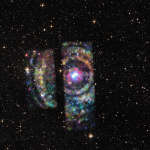 X ray Echoes from Circinus X 1
5.08.2015
Circinus X-1 is an X-ray binary star known for its erratic variability. In the bizarre Circinus X-1 system, a dense neutron star, the collapsed remnant of a supernova explosion, orbits with a more ordinary stellar companion.
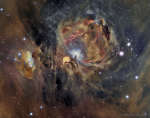 Orion Nebula in Oxygen, Hydrogen, and Sulfur
4.10.2020
Few astronomical sights excite the imagination like the nearby stellar nursery known as the Orion Nebula. The Nebula's glowing gas surrounds hot young stars at the edge of an immense interstellar molecular cloud.
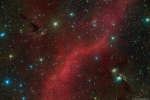 North of Orion s Belt
5.11.2020
Bright stars, interstellar clouds of dust and glowing nebulae fill this cosmic scene, a skyscape just north of Orion's belt. Close to the plane of our Milky Way Galaxy, the wide field view spans just under 5 degrees or about 10 full moons on the sky.
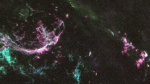 Supernova Remnant: Cooking Elements In The LMC
9.05.1996
Massive stars cook elements in their cores through nuclear fusion. Starting with the light elements of hydrogen and helium, their central temperatures and pressures produce progressively heavier elements, carbon, oxygen, nitrogen, etc. up through iron.
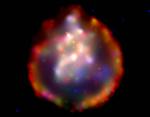 72.6: Oxygen Supply
28.05.2003
A supernova explosion, a massive star's inevitable and spectacular demise, blasts back into space debris enriched in the heavy elements forged in its stellar core. Incorporated into future stars and planets, these are the elements ultimately necessary for life.
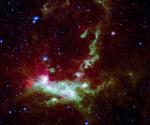 Henize 206: Cosmic Generations
11.03.2004
Peering into a dusty nebula in nearby galaxy the Large Magellanic Cloud, infrared cameras on board the Spitzer Space Telescope recorded this detailed view of stellar nursery Henize 206 filled with newborn stars. The stars appear as white spots within the swirls of dust and gas in the false-color infrared image.
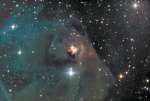 T Tauri and Hind s Variable Nebula
13.12.2007
The orange star centered in this remarkable telescopic skyview is T Tauri, protoytpe of the class of T Tauri variable stars. Nearby it is a dusty yellow cosmic cloud historically known as Hind's Variable Nebula (aka NGC 1555/1554).
|
January February March April May June July August September |
|||||||||||||||||||||||||||||||||||||||||||||||||