
|
You entered: clouds
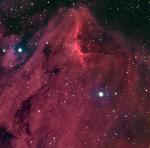 The Pelican in the Swan
29.08.2002
The Pelican Nebula, also known as IC 5070, lies about 2,000 light-years away in the high and far-off constellation of Cygnus, the Swan. This picture spans a portion of the magnificent nebula about 30 light-years wide.
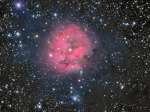 IC 5146: The Cocoon Nebula
27.08.2008
Inside the Cocoon Nebula is a newly developing cluster of stars. Cataloged as IC 5146, the beautiful nebula is nearly 15 light-years wide, located some 4,000 light years away toward the northern constellation Cygnus.
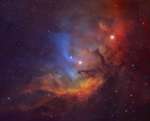 The Tulip in the Swan
26.07.2012
Framing a bright emission region this telescopic view looks out along the plane of our Milky Way Galaxy toward the nebula rich constellation Cygnus the Swan. Popularly called the Tulip Nebula the glowing cloud of interstellar gas and dust is also found in the 1959 catalog by astronomer Stewart Sharpless as Sh2-101.
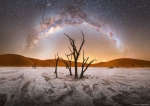 Milky Way over Deadvlei in Namibia
18.04.2018
What planet is this? It is the only planet currently known to have trees. The trees in Deadvlei, though, have been dead for over 500 years. Located in Namib-Naukluft Park in Namibia (Earth), saplings grew after rainfall caused a local river to overflow, but died after sand dunes shifted to section off the river.
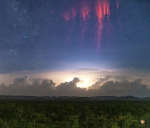 Red Sprite Lightning over Kununurra
25.02.2019
What are those red filaments in the sky? It is a rarely seen form of lightning confirmed only about 30 years ago: red sprites. Recent research has shown that following a powerful positive cloud-to-ground...
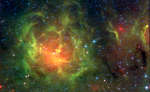 Spitzer s Trifid
13.02.2020
The Trifid Nebula, also known as Messier 20, is easy to find with a small telescope. About 30 light-years across and 5,500 light-years distant it's a popular stop for cosmic tourists in the nebula rich constellation Sagittarius.
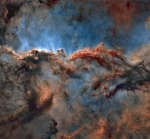 APOD: 2024 June 19 Б NGC 6188: Dragons of Ara
19.06.2024
Do dragons fight on the altar of the sky? Although it might appear that way, these dragons are illusions made of thin gas and dust. The emission nebula NGC 6188, home to the glowing...
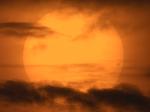 A Picturesque Venus Transit
23.06.2004
The rare transit of Venus across the face of the Sun earlier this month was one of the better-photographed events in sky history. Both scientific and artistic images have been flooding in from the areas that could see the transit: Europe and much of Asia, Africa, and North America.
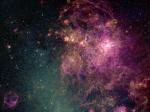 30 Doradus: The Tarantula Zone
12.12.2005
The Tarantula Nebula is more than 1,000 light-years across - a giant emission nebula within our neighboring galaxy the Large Magellanic Cloud. Inside this cosmic arachnid lies a central young cluster of massivestars, cataloged as R136, whose intense radiation and strong winds have helped energize the nebular glow and shape the spidery filaments.
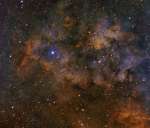 Sharpless 115
14.06.2013
Sharpless 115 stands just north and west of Deneb, the alpha star of Cygnus the Swan in planet Earth's skies. Noted in the 1959 catalog by astronomer Stewart Sharpless (as Sh2-115) the faint...
|
January February March April May June July August September |
|||||||||||||||||||||||||||||||||||||||||||||||||