
|
You entered: gas
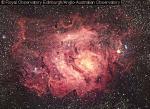 M8: The Lagoon Nebula
7.07.1998
The bright Lagoon Nebula is home to a diverse array of astronomical objects. Particularly interesting sources include a bright open cluster of stars and several energetic star-forming regions. The general red glow is caused by luminous hydrogen gas, while the dark filaments are caused by absorption by dense lanes of dust.
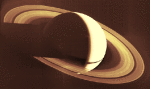 The Night Side of Saturn
5.07.1995
This image of Saturn was made in November 1980 by the Voyager 1 spacecraft as it flew past the ringed gas giant planet. From a spectacular vantage point, looking back toward the inner solar system, the robot spacecraft recorded this view of the night side of Saturn casting a sharp shadow across the bright rings.
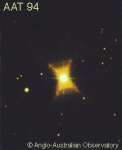 The Red Rectangle
2.11.1995
The unusual geometry of this stellar nebula creates somewhat of a mystery. At the nebula's center is a young binary star system that probably created the nebula, but how? This type of nebula shows a "bipolar flow" which carries a significant amount of mass away from the central stars.
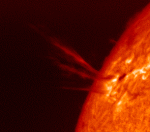 A Solar Corona Ejection
8.11.1996
The Sun would not be a nice place to spend the summer. One reason, besides the extreme heat, is that explosions are common there. In the above picture, magnetic fields buckle releasing previously constrained hot material from the upper atmosphere of the Sun.
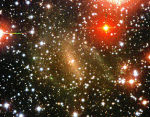 Galaxy Dwingeloo 1 Emerges
1.03.1997
Sometimes you can't see the forest for the trees. But if you look closely at the center of the above photograph, you will see a whole spiral galaxy behind the field of stars.
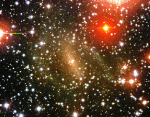 Galaxy Dwingeloo 1 Emerges
2.08.1998
Sometimes you can't see the forest for the trees. But if you look closely at the center of the above photograph, you will see a whole spiral galaxy behind the field of stars.
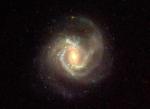 M61: Virgo Spiral Galaxy
22.09.1998
M61 is a barred spiral galaxy located in the nearby Virgo Cluster of Galaxies. Visible in M61 are a host of features common to spiral galaxies: bright spiral arms, a central bar, dust lanes, and bright knots of stars. M61, also known as NGC 4303, in similar to our own Milky Way Galaxy.
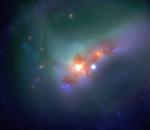 ESO202-G23: Merging Galaxies
1.01.1999
ESO202-G
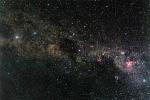 The Milky Way Near the Southern Cross
18.06.2000
This breathtaking patch of sky would be above you were you to stand at the South Pole of the Earth. Just above and to the right of this photograph's center are the four stars that mark the boundaries of the famous Southern Cross.
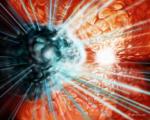 Lasers in Eta Carinae
29.11.1997
Have you heard about the great LASER light show in the sky? A team led by K. Davidson (U. Michigan) and S. Johansson (U. Lund) discovered that the chaotically variable star Eta Carinae emits ultraviolet light in such a narrow band that it is most probably LASER light!
|
January February March April May |
|||||||||||||||||||||||||||||||||||||||||||||||||