
|
You entered: star cluster
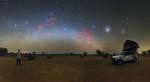 A Kalahari Sky
30.05.2017
You wake up in the Kalahari Desert in Botswana, Africa. You go outside your tent, set up your camera, and take long exposures of the land and sky. What might you see? Besides a lot of blowing dust and the occasional acacia tree, you might catch many sky wonders.
 APOD: 2023 April 8 Б M100: A Grand Design Spiral Galaxy
8.04.2023
Majestic on a truly cosmic scale, M100 is appropriately known as a grand design spiral galaxy. It is a large galaxy of over 100 billion stars with well-defined spiral arms that is similar to our own Milky Way Galaxy.
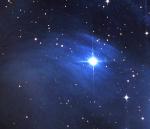 Reflection Nebula NGC 1435
1.03.1999
Reflection nebulae reflect light from a nearby star. Many small carbon grains in the nebula reflect the light. The blue color typical of reflection nebula is caused by blue light being more efficiently scattered by the carbon dust than red light.
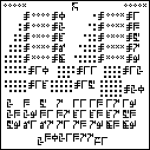 A Cosmic Call to Nearby Stars
2.04.2006
If you could send a message to an alien civilization, what would you say? The people from the Cosmic Call project sent the above image as the first page of a longer message. The message was broadcast toward local stars by radio telescope during the summer of 1999. Another message was sent in 2003.
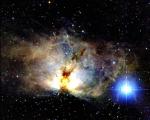 The Flame Nebula in Infrared
13.07.1999
What lights up the Flame Nebula? Fifteen hundred light years away towards the constellation of Orion lies a nebula which, from its glow and dark dust lanes, appears like a billowing fire. But fire, the rapid acquisition of oxygen, is not what makes this Flame glow.
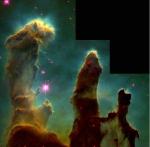 Stars from Eagle's EGGs
12.04.1998
Newborn stars are forming in the Eagle Nebula. This image, taken with the Hubble Space Telescope in 1995, shows evaporating gaseous globules (EGGs) emerging from pillars of molecular hydrogen gas and dust. The giant pillars are light years in length and are so dense that interior gas contracts gravitationally to form stars.
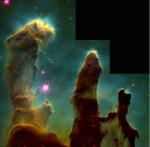 Stars from Eagles Eggs
2.05.1999
Newborn stars are forming in the Eagle Nebula. This image, taken with the Hubble Space Telescope in 1995, shows evaporating gaseous globules (EGGs) emerging from pillars of molecular hydrogen gas and dust. The giant pillars are light years in length and are so dense that interior gas contracts gravitationally to form stars.
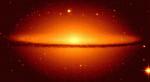 M104: The Sombrero Galaxy
8.02.1997
The famous Sombrero galaxy (M104) is a bright nearby spiral galaxy. The prominent dust lane and halo of stars and globular clusters give this galaxy its name. Something very energetic is going on in the Sombrero's center, as much X-ray light has been detected from it.
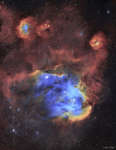 IC 2944: The Running Chicken Nebula
20.04.2020
To some, it looks like a giant chicken running across the sky. To others, it looks like a gaseous nebula where star formation takes place. Cataloged as IC 2944, the Running Chicken Nebula spans about 100 light years and lies about 6,000 light years away toward the constellation of the Centaur (Centaurus).
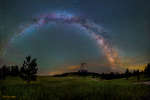 Milky Way over Devils Tower
30.10.2014
A mysterious formation known as Devils Tower rises into the dark above northeastern Wyoming's prairie landscape in this 16 frame panoramic view. Seen against the night sky's thin, pale clouds and eerie...
|
January February March April May |
|||||||||||||||||||||||||||||||||||||||||||||||||