
|
You entered: emission
 Journey to the Center of the Galaxy
11.04.2004
In Jules Verne's science fiction classic A Journey to the Center of the Earth, Professor Hardwigg and his fellow explorers encounter many strange and exciting wonders. What wonders lie at the center of our Galaxy?
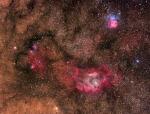 Sagittarius Triplet
14.06.2006
These three bright nebulae are often featured in telescopic tours of the constellation Sagittarius and the crowded starfields of the central Milky Way. In fact, 18th century cosmic tourist Charles Messier cataloged two of them; M8, the nebula below and right of center, and colorful M20 at the upper right.
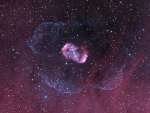 A Halo for NGC 6164
7.05.2009
Beautiful emission nebula NGC 6164 was created by a rare, hot, luminous O-type star, some 40 times as massive as the Sun. Seen at the center of the cosmic cloud, the star is a mere 3 to 4 million years old.
 In the Center of the Trifid Nebula
11.10.2015
Clouds of glowing gas mingle with dust lanes in the Trifid Nebula, a star forming region toward the constellation of the Archer (Sagittarius). In the center, the three prominent dust lanes that give the Trifid its name all come together.
 Protostellar Outflows in Serpens
27.06.2024
Jets of material blasting from newborn stars, are captured in this James Webb Space Telescope close-up of the Serpens Nebula. The powerful protostellar outflows are bipolar, twin jets spewing in opposite directions. Their directions are perpendicular to accretion disks formed around the spinning, collapsing stellar infants.
 APOD: 2025 March 11 Б NGC 1672: Barred Spiral Galaxy from Hubble
11.03.2025
Many spiral galaxies have bars across their centers. Even our own Milky Way Galaxy is thought to have a modest central bar. Prominently barred spiral galaxy NGC 1672, featured here, was captured in spectacular detail in an image taken by the orbiting Hubble Space Telescope.
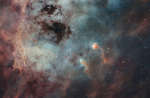 APOD: 2026 March 17 Б The Tadpoles of IC 410
17.03.2026
This telescopic close-up shows off the central regions of otherwise faint emission nebula IC 410, captured under backyard skies. Presented in a Hubble color palette, the image combines visible broadband and narrowband data with data from the near-infrared. Below and right of center are two remarkable inhabitants of the interstellar pond of gas and dust.
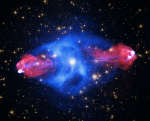 Light from Cygnus A
23.01.2015
Celebrating astronomy in this International Year of Light, the detailed image reveals spectacular active galaxy Cygnus A in light across the electromagnetic spectrum. Incorporating X-ray data ( blue) from the orbiting Chandra Observatory, Cygnus A is seen to be a prodigious source of high energy x-rays.
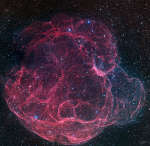 Simeis 147: Supernova Remnant
21.11.2019
It's easy to get lost following the intricate looping filaments in this detailed image of supernova remnant Simeis 147. Also cataloged as Sharpless 2-240 it goes by the popular nickname, the Spaghetti Nebula.
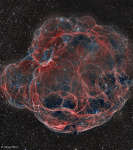 Simeis 147: Supernova Remnant
10.12.2020
It's easy to get lost following the intricate looping filaments in this detailed image of supernova remnant Simeis 147. Also cataloged as Sharpless 2-240 it goes by the popular nickname, the Spaghetti Nebula.
|
January February March April May June July August |
||||||||||||||||||||||||||||||||||||||||||||||||||||||||